Snow White doesn’t want to wait any longer. She wants her turn at last. And she knows perfectly well that this is where things become truly interesting. Because the older versions brought quite a bit to the surface. And they raised a fascinating question:
What does it say about a culture when you look at whom it recognizes as the guardian of what is hidden? Because in the older versions, it wasn’t always the dwarfs. Quite often it was robbers, but dragons and giants also watched over Snow White.
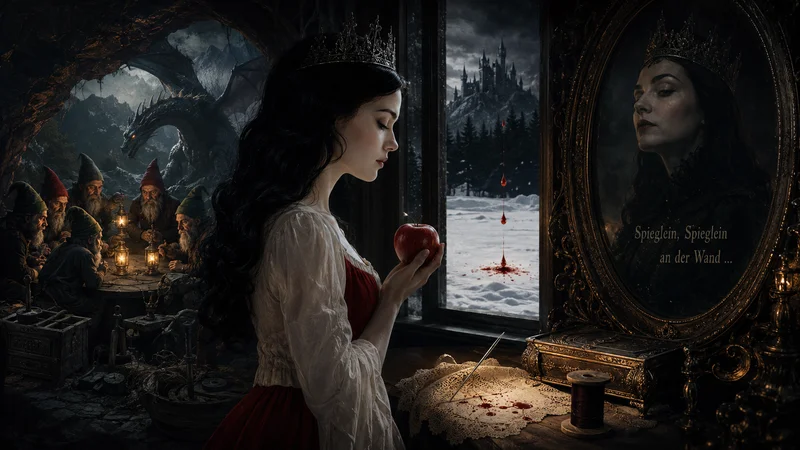
Dwarfs guard ore and gold. Robbers guard themselves. And dragons—in the Albanian version—they guard ancient knowledge of everything. They are the guardians of the threshold itself. Snow White doesn’t simply arrive at a refuge. She arrives at the transition itself…
There’s a great deal buried here—especially the dwarfs, who are anything but children’s book characters. And the mother swap of 1819. And…
Okay, let’s go:
Before the Fairy Tale Begins, There Are Three Colors
White as snow. Red as blood. Black as ebony.
A queen sits at a window framed in black, sewing, and pricks her finger. Three drops of blood fall onto the snow. She looks at them—and wishes for a child with exactly those colors. The child is born. The mother dies.
That is how it begins. Not with good versus evil, but with birth and death in the same sentence.
What the First Edition of Children’s and Household Tales Says
The fairy tale is called Sneewittchen. The woman who wants the child killed is her biological mother. Not her stepmother. Her mother.
In 1819, Wilhelm Grimm changes this. He wants to protect the bourgeois ideal of the sacred mother. So a new wife of the king takes her place. Evil becomes a stranger. An evil stepmother explains herself almost automatically—that isn’t a mystery, it’s a role.
The biological mother, on the other hand, is a mystery. The woman who wished for the child in those three colors now wishes her away. The woman who carried the child within herself sends her into the forest to be killed.
That is the original conflict the fairy tale knows—and the one the Grimms buried: the nurturing mother and the devouring mother are the same woman. Not two different women. One.
The Three Colors
White. Red. Black. This is not an aesthetic program.
In alchemy, these three colors represent the stages of transformation.
- Nigredo — black. Decay, dissolution, the death of what came before.
- Rubedo — red. Transformation, fire, the living force that prevails.
- Albedo — white. Completion, purity, what remains.
The fairy tale begins with all three at once. Blood on snow before ebony. Transformation is not the ending. It is the starting point.
Snow White carries these three colors within herself: skin as white as snow, lips as red as blood, hair as black as ebony. She is not beautiful like a picture. She is beautiful like a process.
The Mirror
It never lies. That is its offense.
The queen asks it every day. It answers every day. As long as she is the fairest, it confirms what she wants to hear. Then comes the day when Snow White turns seven—and it no longer does. That is what makes it her enemy.
Not because it lies. Because it has stopped saying what she wants to hear. A mirror that shows only what is is the most dangerous thing in the world to someone who wants to see only what, in her own mind, ought to be.
Mirror, mirror on the wall… - That is not an innocent question. It is the daily question: Am I still who I want to be? Tell me that I still am.
The mirror refuses to give that confirmation. And that is where everything begins.
The Seven Dwarfs
Every evening, they return from the mountains. They mine ore and gold. They hold their little lights up to the face of the sleeping girl and exclaim: Good heavens, what a beautiful child.
They are not housekeepers. They are guardians.
In Germanic mythology, dwarfs lived beneath rocks and inside mountain passages—skilled craftsmen, tireless workers, smiths of what is hidden, guardians of treasures beneath the earth. Even in the Edda, the dwarf appears as the keeper of what lies below the surface.
And seven. Why seven?
In antiquity there were seven heavenly bodies, seven days of the week—Sun, Moon, Mars, Mercury, Jupiter, Venus, Saturn.
The Earth, surrounded by the seven. Snow White as the Earth, protected by the spirits of the planets.
This isn’t a children’s fairy tale. It’s cosmology in little pointed caps.
The Three Attempts at Murder
The laces, the comb, and the apple.
Each time Snow White opens the door, even though the dwarfs told her not to. Each time she lets herself be charmed by something beautiful. Each time she falls.
The first attack strikes the body—the laces take away her breath.
The second strikes the head—the poisoned comb works through her hair, the seat of strength and thought.
The third strikes the soul—the apple, divided into red and white, seduces through outward appearance.
Only after all three layers have been attacked is the transformation complete. Snow White must die three times in order to awaken three times. Not because the fairy tale is cruel. Because transformation does not happen all at once.
And every time: the door. She opens the door even though she knows she shouldn’t. That is not a flaw in her character—it is simply human. Compassion for the old woman. Delight in something beautiful. Trust at first sight.
That is also what separates her from her mother. The mother looks into the mirror. Snow White opens the door.
No Kiss
In the original, Snow White does not awaken through a kiss.
One of the prince’s servants, exhausted from carrying the heavy coffin everywhere, strikes her on the back in frustration. The piece of apple lodged in Snow White’s throat is knocked loose.
The spell is broken by something utterly ordinary.
No romantic moment. No prince deciding to do the right thing. Instead — a weary servant. A shove. And just like that, life returns.
Disney turned it into a kiss—once again. Understandable for its own purposes, because a kiss is more beautiful.
But the blow from the irritated servant is more honest.
It says: Sometimes the thing blocking us comes loose through the unexpected. Through someone else’s misstep. Through the moment nobody planned.
The Punishment
The queen is invited to the wedding. She comes because she must—because the mirror has told her who is getting married. She recognizes Snow White. She stands there, unable to move.
Then red-hot iron shoes are brought in. She must dance in them until she falls dead to the ground.
That is the old law of the fairy tale. No mercy. No repentance that counts. No second chance. Whoever has tried three times to kill a child—the first time through the body, the second through the mind, the third through the soul—now dances in burning iron.
This is not revenge. It is symmetry. The queen sent Snow White to her death three times. Now she herself carries death in her shoes.
What the Mother Wanted
But first, back to the beginning. Back to the biological mother.
She sits at the black-framed window and sews. She pricks her finger. She sees blood on snow and thinks of a child. Of this very child—white, red, black.
She wishes for her. The child is born, and she dies.
And then — in the 1812 version — she returns. Transformed. No longer nurturing, but devouring. No longer wishing, but destroying. She sends the child she longed for into death.
Why?
The fairy tale offers no answer. It merely holds up the mirror. And the mirror says: You are no longer the fairest. The child is more beautiful. The child is what you wished for.
That is the most unsettling thing in the entire story. Not the witch. Not the magic mirror. Not the poisoned apple.
But that the thing we once wished for eventually becomes more beautiful than we are — and that we may not be able to bear it.
Before the Grimms Came
The Brothers Grimm did not invent Snow White. They rediscovered it—and reshaped it. How far back the pattern reaches becomes clear in three versions that are older than, or independent of, the Grimm version.
Naples, 1634 – Giambattista Basile
In the Pentamerone, the oldest European collection of fairy tales, there is a story called La schiavottella — The Little Slave. It is considered the earliest written relative of Snow White.
A woman swallows a rose petal while playing and becomes pregnant because of it. Friendly fairies bless the child at birth—but one fairy arrives late, stumbles, twists her ankle, and, in her pain, curses the child: in her seventh year she will die while having her hair combed. And that is exactly what happens.
The child lies in a crystal coffin. A baron guards the key. His new wife—consumed by jealousy and burning with envy—finds the coffin anyway. She sees the beauty inside and angrily yanks the girl by her hair. The comb falls out. The child awakens.
Salvation comes through anger. Not through love. Not through a kiss. Not through an accidental shove. Through the rage of a jealous woman who wants to destroy the girl—and in doing so, sets her free.
That is Basile. He was a Baroque poet, not a moral educator. He told the story as it was.
No mirror. No poisoned apple. The curse itself comes through an accident, not through malice. And redemption — comes through an enemy.
Greece – Rodia
In the Greek folk version, there is no mirror. The queen asks the Sun.
The Sun answers truthfully: Your sister Rodia is more beautiful than you. Rodia is abandoned because of this. But she does not come to the dwarfs. She comes to the Queen of the Night.
The Sun, as the all-knowing witness, is older than any mirror. It does not judge. It reveals. And what it reveals cannot be denied.
The Glass Mountain
In a German version from 1809 — before the Grimms — the dwarfs do not live beyond seven mountains. They live upon the Glass Mountain.
Snow White does not lie in a glass coffin. She lies upon the Glass Mountain.
In pre-Christian times, the Glass Mountain symbolized a place of the dead—a place between worlds, belonging neither fully to this side nor to the other. A place of glass: transparent, cold, suspended between being and not being.
That is a different image from the coffin. The coffin is an ending. The Glass Mountain is a state of being.
What These Three Versions Reveal
The underlying pattern appears everywhere. Beauty that is threatened. A sleep that is not death. An awakening brought about by the unexpected. But every culture places its emphasis differently. Basile turns the enemy into the savior. The Greeks replace the mirror with the Sun. The old German tradition transforms the coffin into a place.
Incidentally, in the Albanian folk version, Snow White does not live with seven dwarfs. She lives with forty dragons.
Not with spirits of the mines. Not with guardians of the planets. With dragons — the guardians of the threshold itself, not of a particular treasure, but of the passage between worlds.
That changes everything. The girl who flees into the hidden world does not arrive among the keepers of the underworld. She arrives among the guardians between worlds.
Out of all these fragments, the Brothers Grimm created a single version. The one that best fit the values of the bourgeois nineteenth century.
Excavation Sites
- Grimm original text, 1812 (Wikisource): https://de.wikisource.org/wiki/Sneewittchen_(Schneewei%C3%9Fchen)_(1812)
- Wikipedia – Snow White, mother vs. stepmother, variants: https://de.wikipedia.org/wiki/Schneewittchen
- Original 1812 version and psychological analysis: https://www.maerchenbrause.de/maerchen/schneewitchen
- Seven dwarfs as planetary spirits, color symbolism: https://bildpostkarten.uni-osnabrueck.de/frontend/index.php/Detail/entities/schneewittchen
- Dwarfs in Norse mythology: https://www.maerchenatlas.de/miszellaneen/marchenfiguren/zwerge-im-marchen/
- Alchemical interpretation: https://www.maerchen.pushpak.de/schneewittchen.html
- Basile – La schiavottella (The Little Slave): https://de.wikipedia.org/wiki/Die_kleine_Sklavin
- Basile – Pentamerone, complete German text: https://www.projekt-gutenberg.org/basile/pentamer/pentamer.html