There is one sentence in this fairy tale that makes everything else, in a way, unnecessary.
The donkey says it to the dog as he lies exhausted by the roadside, cast aside and condemned to die: “You’ll find something better than death anywhere.”
It sounds like optimism, but it is actually the zero point—the only justification that was ever needed to set out on a journey. They leave, but they never arrive in Bremen. They never become town musicians, either. And yet the fairy tale still ends well.
That is no accident. That is the fairy tale.
Layer 1: Four Sacred Animals on the Road to Nowhere
Before we set out with the donkey, it is worth taking a look at what these four animals meant in older cultures.
The donkey is not stupid. That is a northern misunderstanding of a southern animal that was held in high regard in its homeland. Around the Mediterranean, the donkey was sacred to Dionysus—the god of ecstasy, intoxication, and transformation. It carries burdens, it endures, it walks its path stubbornly and without distraction. What the North interprets as stubbornness is, at its core, steadfastness.
The dog. In nearly every ancient culture of Europe, it is the companion of the dead—a psychopomp, a guardian of thresholds. Hecate is accompanied by dogs, Cerberus guards the underworld, Managarm carries souls to Valhalla. The dog knows how to cross thresholds. It knows the scent of death—and still it keeps going.
The cat. In Egypt, Bastet, goddess of protection and the warmth of the home. In Norse tradition, Freya rides in a chariot pulled by cats. The cat is the creature that moves between worlds, that sees in the night, that cannot be bound. Whatever people may intend for it, in the end it remains itself.
The rooster. He crows when the night comes to an end. He calls in the day. In almost every tradition, he is the guardian of the threshold between darkness and light—he drives away demons, he announces the new. The Assyrians saw him as the symbol of the fire god. He stands atop church steeples because he possesses the power to drive away evil.
Four animals. In the ancient world, each of them fulfilled a role at the threshold. Each one stood somewhere between worlds. And now they are to be slaughtered because they are no longer useful.
That is the true scandal of the fairy tale—not that they are no longer useful. But that there are people who think that this is reason enough.
Layer 2: The Fairy Tale
First published in the second edition of the Children’s and Household Tales in 1819 as KHM 27. The sources are unknown—the tale belongs to the European narrative tradition of “Animals on a Journey,” which appears in many different versions throughout the continent.
Along the way, he met an old hunting dog lying by the roadside—his master wanted to kill him because he could no longer hunt. The dog joined the donkey. Then they met a cat whose teeth were no longer sharp enough to catch mice and who was to be thrown into the water. Finally, they came across a rooster whose mistress intended to wring his neck because she wanted to make soup.
All four set out for Bremen. When night fell, they saw a light shining through the forest. They approached it and found a robber’s house. Looking through the window, they saw the robbers sitting at the table, eating in the light of a lamp.
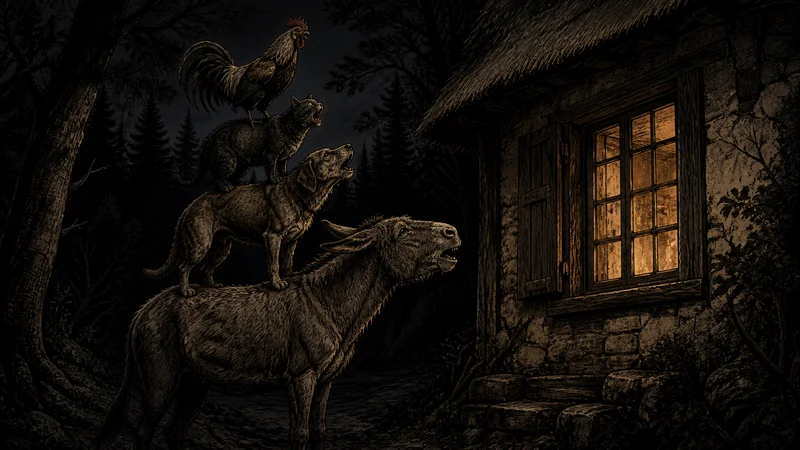
The animals took their positions: the donkey placed his front feet on the windowsill, the dog jumped onto his back, the cat climbed onto the dog, and the rooster perched on top. At a signal, they all began to shout and sing—the donkey brayed, the dog barked, the cat meowed, and the rooster crowed. They crashed through the window into the room, the lamp fell over, and the robbers fled screaming into the forest, convinced that a monster had taken over the house.
The four animals ate, put out the light, and went to sleep—each in its own place. The donkey on the dung heap, the dog behind the door, the cat on the hearth, and the rooster up in the rafters.
In the middle of the night, the robber chief sent one of his men back to see whether the monster had gone. He stepped into the darkness, saw the glowing eyes of the cat on the hearth, mistook them for hot coals—and received her claws across his face. He stumbled, stepped on the dog, who bit him in the leg. Outside, the donkey kicked him with his hind leg, and the rooster crowed. Terrified, the robber ran back and told his companions about the monsters: an old witch who had scratched him with her fingernails, a man with a knife, a black beast that had struck him, and a judge above who shouted, “Bring me that scoundrel!”
The robbers never returned. And the four animals stayed in the house because they felt so comfortable there that they no longer wanted to continue their journey.
What Is Really Being Told Here
The Destination Is Not the Goal
Bremen is a direction, not a destination.
The fairy tale never says this outright—but it shows it. Not one of the four animals ever asks, “How much farther is it?” They simply keep walking. The destination is the impulse that sets them in motion. What they need is not the city. What they need is the road leading toward it.
This is one of the most radical statements a fairy tale can make: The wish does not have to be fulfilled. It only has to be real enough to make you set out.
Anyone who waits until they know whether it will work is already dead. The donkey knows this—he is the first to begin the journey. Not because he is certain, but because the alternative is the knife.
“You’ll Find Something Better Than Death Anywhere”
That is the first sentence the donkey says to the others. It sounds fatalistic. It is the exact opposite.
It is simply an assessment of the situation. Anything that is not death is better than death. That includes the uncertain, the uncomfortable, the unfamiliar, and the risky. The donkey offers no guarantee of success—he offers a statement about direction. Leaving is better than staying.
This is not naïveté. It is the basic condition for every new beginning.
The Pyramid
At the decisive moment, they climb onto one another.
Donkey. Dog. Cat. Rooster.
This is not a random stack. Whether intentional or not, it reflects the four layers of the world these animals represent in ancient symbolism: earth, the middle world, the threshold, and the heavens. The donkey bears the weight. The dog connects. The cat sees in the darkness. The rooster calls forth the light.
Together they are everything. Alone, each would be nothing. As a pyramid, they become a single being that the robbers mistake for a monster—because there is nothing else quite like it.
The monster is not a beast. It is community.
What the Robber Sees
The robber who is sent back experiences each animal exactly as ancient symbolism portrays it: the cat on the hearth is a witch, the dog an armed man, the donkey a monster, and the rooster a judge. He reads the house as a place inhabited by supernatural powers—and he is not entirely wrong.
What he does not understand is this: these are not powers pursuing him. They are animals that simply want to sleep.
The terror is not intentional. It is the natural result of four beings remaining true to their own nature, at night, in their own places, without any regard for human expectations.
That is the most subversive statement in the fairy tale: The outcasts do not have to disguise themselves, adapt, or prove themselves. They only have to be who they are—and that is enough.
They Never Arrive
This is the paradox that carries the fairy tale.
Bremen is the destination—and it remains the destination. They never reach it. And the fairy tale says: good. Because what they found is better than what they were looking for. Not because Bremen would have been a bad place, but because, along the way, something came into being that mattered more than any destination ever could.
Community. Ability. A place to belong.
Many fairy tales reward arrival. This one rewards the journey itself. The ability to set out is the true gift—not whatever may be waiting at the end.
What the Moralizing Interpretation Makes of It
The standard message is this: Unity and courage lead to success.
That is not wrong. But it does not go deep enough.
The fairy tale is not about the weak defeating the strong. It is about what happens when animals—or people—are no longer judged by their usefulness. If you ask the question the miller, the hunter, and the farmer’s wife asked, you carry the wrong question with you.
The right question is not: What use are you? It is: What are you capable of once you have stopped being useful?
What the Fairy Tale Says
Four animals facing death decide to set out. They have a plan that never comes to pass. They find something even better.
Not because they were clever. Not because they were virtuous. But because they started walking.
The destination was the direction. The road became home.
And in Bremen, no rooster ever crows for them.
Unearthed at:
- Grimm, KHM 27 (from the 2nd edition, 1819): https://www.grimmstories.com/de/grimm_maerchen/die_bremer_stadtmusikanten
- European tale type, sociohistorical context: https://de.wikipedia.org/wiki/Die_Bremer_Stadtmusikanten
- Donkey symbolism (Dionysus, northern misinterpretation): https://www.maerchenatlas.de/miszellaneen/marchenfiguren/tiere-im-maerchen-der-esel/
- Dog as psychopomp, guardian of thresholds, Cerberus: https://mydog365.de/magazin/wissen/uebernatuerliche-hunde/
- Rooster as guardian of thresholds, symbolism of fire/sun/demons: https://www.welt-der-katzen.de/hexen/mythen/804455acfa0908701.html