Who’s afraid of the Big Bad Wolf?
Boys like Peter certainly aren’t…
Like every fairy tale, this one also conveys an interesting piece of wisdom when you read the story through the eyes of the little bird—the metaperspective. It became one of the most frequently performed masterpieces of classical music, almost perfectly reinforcing the story through its music while conveying its emotions.
And—it is older than is commonly known, because “the most living thing in the story is what has been swallowed”—this quietly connects Peter and the Wolf with The Wolf and the Seven Young Kids, with Cronus, with Jonah. A pattern woven through every age.
Let’s begin:
Layer 1: The Man Behind the Fairy Tale
Moscow, 1936. Stalin is in power. Prokofiev has just returned from Paris—not out of conviction, but because the stock market crash wiped out his fortune, and the Soviet Union has become his financial security. He immediately receives a commission: he is to write a musical fairy tale for children that will introduce them to the instruments of the orchestra.
The first libretto is already on his desk. A Young Pioneer named Peter who loves his homeland, obeys his parents, studies diligently, is neat and orderly, plays sports, and above all—corrects a mistake by questioning his grandfather’s attitude. A lesson in socialist virtues disguised as a fairy tale.
Its original working title: The Pioneer Petya. A child of the Soviet Union who defeats the threat. That is how the state would have liked to read it. Prokofiev kept the character—but removed the title. What remained was Peter. Just Peter. Without the Young Pioneer badge.
Prokofiev writes his own text. In only two weeks. He later says: the fairy tale was merely the pretext. What mattered was the music.
He died on March 5, 1953, in Moscow. The very same day as Stalin. News of his death disappeared beneath the noise of national mourning. Barely thirty people paid him their respects. The man who had written the most frequently performed work of classical music for children was buried almost unnoticed.
That is not a biographical detail. It is the context from which this work emerged: an artist living inside a system that silences voices. Who writes anyway. Who writes a fairy tale about how to keep your own voice.
What he wrote has since become one of the most frequently performed works of classical music anywhere in the world. Nobody survived the propaganda piece… except—the archetype.
A Pattern Woven Through the Centuries
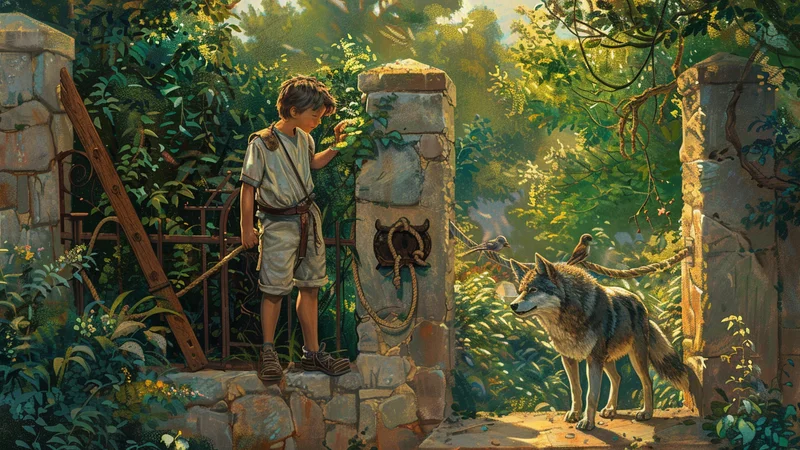
A boy. A wolf. A garden with a gate. The gate stands open—and the boy goes outside even though his grandfather forbade it. For the grandfather is worried: What if the wolf comes out of the forest? It’ll eat you…
And the wolf comes. The duck is swallowed. Peter catches the wolf—with a rope, with cleverness, and with the help of the little bird. When the hunters arrive, Peter manages to save the wolf—the wolf is not killed but taken to the zoo.
And at the very end it becomes clear: if you listen very carefully, the duck is still quacking inside the wolf’s belly. Alive. Swallowed, but not digested.
That is it—the ancient pattern. Jonah in the whale. The young goats inside the wolf’s belly. What has been swallowed continues to live. What has been taken in does not cease to exist.
Layer 2: The Fairy Tale
Sergei Prokofiev, “Peter and the Wolf,” Op. 67 (1936). A symphonic fairy tale for narrator and orchestra. Premiered on May 2, 1936, by the Moscow Philharmonic.
The grandfather arrives, scolds Peter, and takes him by the hand: the wolf might come. The gate must be closed, and Peter must return to the garden.
The wolf really does appear and swallows the duck. The cat escapes into the tree. Peter fetches a long rope and climbs over the wall—the bird distracts the wolf while Peter throws the rope and catches the wolf by its tail.
Hunters come out of the forest carrying rifles, but Peter calls out: Don’t shoot! We’ll take him to the zoo.
The procession sets off: Peter in front, then the wolf on the rope, the hunters behind them, followed by the grandfather and the cat. And if you listen very carefully, you can still hear—from inside the wolf’s belly—the duck quacking.
What Is Really Being Told Here
The Seven Voices
Prokofiev gave this fairy tale something no Grimm fairy tale has: a complete musical assignment. Every character has an instrument. Every character has a theme. And whenever several characters appear together, their themes are heard at the same time—interwoven, layered, in conversation with one another.
That is not a pedagogical gimmick; it is a statement about consciousness.
We all carry these voices within us. The cautious grandfather—the bassoon, heavy, grumbling, warning. The light bird—the flute, high, quick, carefree. The stalking cat—the clarinet, velvety, sly. The comfortable duck—the oboe, waddling, self-satisfied. The wolf—three French horns, dark and inescapable. The hunters—trumpets and timpani, loud, confident, too late.
And Peter—the strings, bright, curious, agile.
Every one of these themes is an inner voice. The question is not which one is real. The question is which one you choose to follow.
The Grandfather
The grandfather is not the villain. He is the voice of experience speaking out of fear.
The bassoon rumbles low and slowly—it is the oldest voice in the piece. It is right: the wolf is dangerous. And at the same time it is wrong, because danger is not a reason never to go outside.
The grandfather closes the gate. And Peter climbs over the wall.
That is not disobedience out of defiance. It is the realization that caution and paralysis are two different things. The grandfather has seen the wolf—and protects himself by never leaving the garden again. Peter has never seen the wolf—and that is exactly why he goes.
Those who do not yet know the wolf can catch it. Those who know it too well believe all they can do is close the gate.
The Bird
The flute is the brightest, quickest voice in the piece. The bird doubts nothing, fears nothing—and is therefore both useless and indispensable.
By itself, it would be lost. It cannot stop the wolf. But it can distract it—just long enough for Peter to throw the rope.
That is the purpose of lightness. The part that does not hesitate, does not plan, does not weigh every possibility—but simply acts. Not out of naivety, but because the situation demands it, and only this voice is fast enough.
The Duck
She was eaten. But we can still hear her.
At the end of the piece, as the triumphant procession moves through the forest, we hear—inside the wolf’s belly, quietly yet unmistakably—the duck’s oboe theme. She has been eaten, but she continues to live as sound.
That is the strangest and deepest thing in this piece. Prokofiev gives the lost duck one final appearance—not as a memory, but as a presence. What is lost does not disappear. It merely changes its form.
“Don’t shoot.”
That is the decisive sentence of the fairy tale. And it comes from Peter.
The hunters arrive with their rifles. They would have shot the wolf. But Peter calls out: No. We’ll take him to the zoo.
That is not weakness, but a decision about what should be done with something dangerous—kill it or confine it? Destroy it or bear witness to it?
Peter chooses the latter. Not because he loves the wolf. But because he needs it alive—as proof, as a trophy, as part of the story he carries with him. A dead wolf proves nothing. A living wolf in the zoo says: I was there. I caught him. I came back.
What Prokofiev Writes—and What He Cannot Write
1936, Moscow. The year the great show trials begin. The year artists learn what they are allowed to say—and what they are not.
Prokofiev writes a fairy tale about a boy who does not follow the advice of his elders, goes out alone, does not destroy what is dangerous but captures it, and in doing so makes the hunters unnecessary.
This is not a fairy tale loyal to the state. It is a very quiet story about what courage means—not the ability to kill the enemy, but the ability to keep it alive and say: Look. It is not beyond control. You simply never tried to catch it.
Prokofiev removed the Young Pioneer badge. He turned “Petya” into “Peter.” He fulfilled the commission—and hid something else inside it.
What the Piece Is Saying
We all carry these seven voices within us: the heavy warning, the buoyant lightness, the stalking cunning, the self-satisfied comfort, the threatening darkness, the loud noise of those who arrive too late—and the bright, agile thread called Peter.
The question is not which voice is true. The question is which one you choose to follow today.
Peter climbs over the wall. Not because he knows no fear—but because his theme belongs to the strings. Light. Bright. Curious.
And deep inside the belly, at the very end, we hear the duck.
What was lost continues to resonate.
Unearthed from:
- Original text (Prokofiev/Remané): https://www.nwd-philharmonie.de/wp-content/uploads/2020/12/Lehrermaterial2021.pdf
- The work, its origins, and orchestration: https://de.wikipedia.org/wiki/Peter_und_der_Wolf
- Prokofiev’s life in the Soviet Union, date of death: https://unprominente.de/2023/09/05/sergei-sergejewitsch-prokofjew-peter-und-der-wolf/
- Original title “The Pioneer Petya”: https://www.buehnen-halle.de/media/filer_public/3f/43/3f439bbd-46ba-4f3f-ba6c-1d0349af8c3a/neu_peter_wolfpadagogisches_begleitmaterial.pdf