A hundred years of sleep… that is not time lost.
My mother would have agreed with that sentence immediately, even without seeing the bigger picture. She always seemed to be tired somehow… but what exactly is meant by this sleep that brings everything to a halt?
A girl sleeps for a hundred years because of a curse. Read superficially, it sounds like an act of malice descending upon an innocent child. But let’s take another, closer look:
A hedge of thorns that kills anyone who comes too early. Too early…
For decades, princes die in the thorns—not because they are foolish, but simply because they arrive too soon. The time has not yet come. And the hedge knows it—it lets no one pass. And then—exactly in the hundredth year—it opens. On its own. The thorns become flowers, and the prince who comes now does not have to fight. He simply walks through.
Sleep is not a prison. It is protection. It holds everything still until the time is right.
Layer 1: The Valkyrie on the Mountain
Long before Charles Perrault wrote down the story, long before the Brothers Grimm included it as KHM 50 in their collection, this image already existed.
On Hindarfjall lies a sleeping warrior. She wears armor, and around her burns a ring of fire—the Waberlohe. Only someone truly fearless can pass through it. Odin, the Allfather, placed her there. With the Svefnthorn—the sleep-thorn. As punishment, because in battle she acted according to her own judgment rather than obeying his command.
Her name is Brynhild. She is a Valkyrie—one of the choosers of fate who decide victory and death on the battlefield. She allowed the wrong king to win. Odin punishes her with sleep—and with the condition that only the bravest of all warriors may awaken her.
Jacob Grimm knew this. In his own notes on Sleeping Beauty, he writes that the sleeping maiden in the castle, surrounded by thorns, is identical to the sleeping Brynhild, surrounded by a wall of flames. Spindle and sleep-thorn—the same image.
The fairy tale is not a story about a naïve girl who injures herself through carelessness. It is a story about a power that has been laid to sleep—and is waiting for someone courageous enough to make their way through the thicket.
Layer 2: The Fairy Tale
First published in 1812, KHM 50. Source: Marie Hassenpflug, through Charles Perrault’s La belle au bois dormant (1697). Oldest known core: Giambattista Basile’s Sole, Luna e Talia (1634). As Grimm himself noted, the motif goes back to the Old Norse legend of Brynhild.
The twelve fairies bestow gifts upon the child: virtue, beauty, wealth—everything a person could wish for. But then, before the twelfth fairy has spoken, the thirteenth enters. Seeking revenge for the insult, she curses the girl: in her fifteenth year, she will prick her finger on a spindle and fall down dead.
The twelfth fairy, who has not yet spoken, cannot lift the curse—but she can soften it. The girl will not die, but sleep for a hundred years.
The king then orders every spindle in the kingdom to be burned. But on her fifteenth birthday, the girl discovers an old woman spinning in a castle tower. She reaches for the spindle, pricks her finger, and falls.
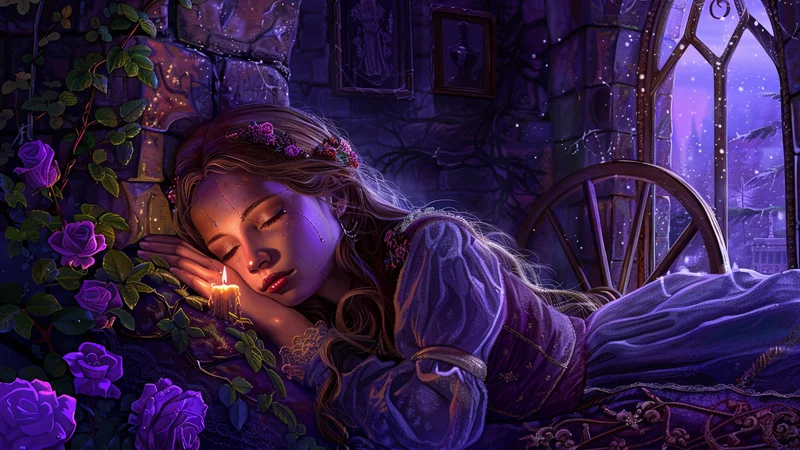
The entire castle falls asleep with her—the king, the queen, the court, the horses, the dogs, the doves, the cook, the kitchen maids, even the flies on the wall. A dense hedge of thorns grows around the castle.
Brave princes desperately try to get through. They die in the thorns.
After a hundred years, when the appointed time has come, roses bloom from the hedge. Another prince arrives, and the thorns give way on their own. He finds the sleeping girl in the tower and is captivated by her beauty. He kisses her, and she awakens. And with her, the entire castle awakens. The fire in the kitchen blazes again, the cook finishes the movement she had begun and slaps the kitchen boy. The doves lift their heads from beneath their wings.
What Is Really Being Told Here
The Thirteenth Fairy
She is the pivotal figure. And she is also the one people think about the least.
She was not invited—simply because there were not enough golden plates. That is what sets everything in motion—not malice, but a limitation, an omission, a gap in the order of things. The incomplete forcing its way into the world.
The thirteenth fairy is not evil. She is wounded. And from that wound she speaks a truth: this child will prick herself. Not because the fairy has bewitched her—but because that is the truth of the fifteenth year. The passage into maturity is always a prick. Always a wound. Always a confrontation with what is sharp, dangerous, with the very thing the father tried to remove from the world.
You can burn every spindle. The wound will still come.
Burning the Spindles
The king believes he is protecting his daughter by destroying the danger. That is the oldest mistake of care.
What he actually does is remove every spindle from the kingdom—except one. The last one, hidden, forgotten—the one in an old tower, with an old woman who may not even know that spindles have been forbidden. That is the one the girl finds.
What is hidden draws us in. What is forbidden tempts us. Not out of rebellion—but out of curiosity. The girl does not reach for the spindle in defiance. She reaches for it because she has never seen one before. Because her entire life has been kept away from this one encounter.
The wound comes from what one was never allowed to know.
Sleep
The castle sleeps. Not just the girl—everything. The king, the cook, even the fly on the wall. This sleep is not an individual state; it is a collective suspension. The girl’s entire world pauses—waits with her, sleeps within her time.
In Celtic mythology, the sleep of the Otherworld is a leap through time: one lies down, time passes, and one returns to a new life without carrying the burden of the years gone by. The girl knows nothing of what happens during those hundred years. She sleeps through them. Yet she does not grow old, she carries no grief, no worry, no burden.
And Brynhild? The Valkyrie lies upon her mountain, in her armor, surrounded by the ring of fire. She, too, sleeps through time. She, too, waits for the one who is courageous enough. And with her as well, the flames grow smaller—not through battle, but because the appointed time has come.
Sleep is not a loss. It is protection—until the right moment arrives.
The Thorns
The thorns kill the princes who try to defy time. Pitifully, the fairy tale says. They become entangled, cannot turn back, and die.
This is not the cruelty of the castle. It is a statement about readiness. Whoever—or whatever—comes too early, before the time has been fulfilled, ends up in the thorns. Not as punishment. As a fact.
And then, in the hundredth year? The thorns become roses, and the prince walks through without a single thorn touching him. Not because he is stronger than the others. But because now the time has come.
This is the most difficult part of the image: not every barrier can be overcome through courage or strength. Some barriers open—or they do not. And that has nothing to do with the one who stands waiting.
Basile, 1634 – The Original Story
Here we should pause for a moment.
In 1634, Giambattista Basile wrote Sun, Moon, and Talia—the oldest written version. It is not romantic. It is not bourgeois. It is Baroque and raw, and it says something that Perrault and the Brothers Grimm later wrote out of the story.
A king out hunting discovers the sleeping Talia in her tower palace. He tries to awaken her—but fails. He sleeps with her and leaves her there.
Fairies care for the twins she later gives birth to. Eventually, the children suck the flax fiber from her finger—and she awakens.
No kiss. No noble prince.
In Basile’s version, it is the woman’s own child who awakens its mother. Not intentionally—but through hunger, through instinct, through the search for what gives nourishment. The newborn finds the fiber and pulls it out.
This is the oldest image. Not redemption through a man. Not rescue from outside. Life emerging from life—and in doing so, bringing back what came before.
Perrault, in 1697, transforms it into a romantic kiss. The Brothers Grimm follow him in 1812. The image we know is the gentlest, the latest, and the most heavily revised.
Aurora – The Dawn
When Disney adapted the story in 1959, he gave the princess the name Aurora. And not by accident.
Aurora is the Roman goddess of the dawn. The one who brings back the light each day. The sister of the sun god Sol.
It seems very likely that Disney, too, recognized the mythological reference in Perrault’s fairy tale—Aurora as the dawn itself, the daughter of daybreak.
Sleeping Beauty as Aurora. The sleeping light. The light that waits a hundred years for its moment—and then, when the time is right, returns.
Sleep is not the night. Sleep is the time before morning.
What the Thirteenth Fairy Is Really Saying
She says: This child will prick herself.
Not: I will punish her. Nor: I wish evil upon her. But rather: this is the truth of life that all of you are trying to hide. Growth hurts. Every transition leaves wounds. Whoever banishes that from the kingdom merely postpones it.
She is not the villain. She is the one who speaks the unavoidable. And for that, she has been read as the villain ever since.
That is the deepest misunderstanding in the Brothers Grimm’s version.
What the Fairy Tale Is Saying
A power is laid to sleep—because it was too early, too strong, too unfinished for the world into which it was born. It sleeps through the time it needs. Around it grows a protection that keeps away everyone who is not yet ready.
When the appointed time has come, that protection opens on its own.
And whoever arrives then finds a woman who has traveled through a hundred years of time without ever knowing it.
Brynhild upon her mountain. Sleeping Beauty in her tower. The same image—for more than a thousand years.
The sleep-thorn has always been the same. Only the one who placed it changes. Odin. The thirteenth fairy. A spindle in a forgotten tower.
The wound comes. Sleep helps and protects. And awakening happens by itself.
Unearthed at:
- Grimm, KHM 50 (first edition, 1812): https://de.wikisource.org/wiki/Dornröschen_(1812)
- Jacob Grimm’s own notes: the Brynhild parallel (sleep-thorn/spindle, ring of fire/thorn hedge): https://bildpostkarten.uni-osnabrueck.de/frontend/index.php/Detail/entities/dornroeschen
- Brynhild, Svefnthorn, Sigurd: https://die-wikinger-taverne.com/blogs/wikinger-blog/svefnthorn-schlafdorn
- Brynhild in the Poetic Edda and the Völsunga Saga: https://de.wikipedia.org/wiki/Br%C3%BCnhild
- Basile, Sole, Luna e Talia (1634) – the original version: Sleeping Beauty as initiation and fertility goddess: https://www.raumundmensch.org/post/dornroeschen
- Sleeping Beauty (Wikipedia): https://de.wikipedia.org/wiki/Dornr%C3%B6schen