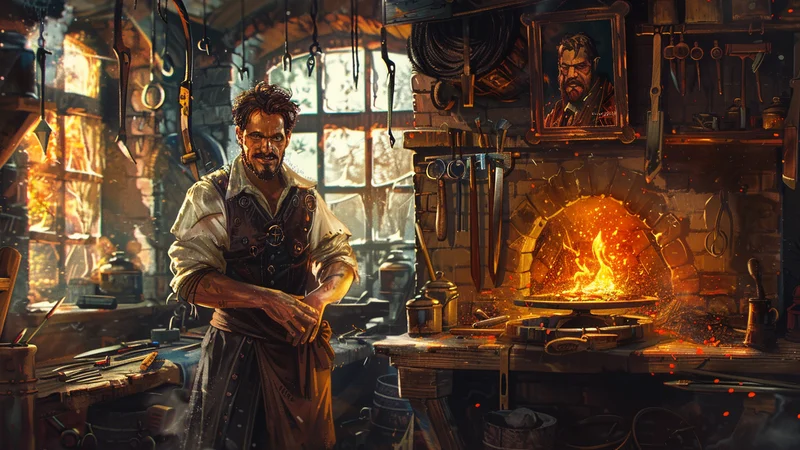
A blacksmith at the end of his strength. A Devil. A bargain. And in the end—neither Heaven nor Hell wants him.
In 2016, researchers from the Royal Society demonstrated that The Smith and the Devil is the oldest traceable fairy tale in the Indo-European tradition.
When it was first told, there was no Greece, no Rome, no Germania. Perhaps it is the oldest fairy tale in Europe?
The core of this story is estimated to be 6,000 years old—dating back to the Bronze Age—older than almost anything else we know. After the first edition, the Brothers Grimm removed it from their collection. Too rough. Too immoral. No happy ending.
And that is precisely why it is worth taking a closer look.
Layer 1: The Outcast with the Greatest Gift
In Greek mythology, Hephaestus—the god of fire, blacksmithing, and transformation—is thrown from Olympus twice. Once by his mother Hera because he was born ugly and lame. Once by Zeus because, during his parents’ quarrel, he took his mother’s side.
He lands in the sea. He lands on Lemnos. He limps. He is the only craftsman among the Olympians—the only god who works with his hands, who sweats, who needs fire. And he is the most dangerous of them all, because he forges the weapons of the gods, Achilles’ armor, Poseidon’s trident, and Hermes’ winged sandals.
The outcast creates what everyone else depends on. That is the paradox of the blacksmith in every culture.
In Norse tradition, there is Wayland the Smith—imprisoned on an island, crippled, enslaved, and ultimately taking revenge.
In Germanic legends, the blacksmith is the one who works with fire: the element that turns wood into ashes and ore into a sword. He lives on the edge of the village, often far beyond it. He smells of smoke and coal. He is necessary and feared at the same time.
Jacob Grimm himself writes in his notes on this fairy tale that one might imagine Thor as the blacksmith, and a giant as the Devil.
That is not a modern interpretation. That is the author himself saying: You know what this really is. A god negotiating with chaos. And winning.
Layer 2: The Fairy Tale
KHM 81a, included only in the first edition of 1812. Sources: oral tradition, related to The Smith of Jüterbog (Bechstein), Spielhansl (KHM 82), and European variants from Basile’s Pentamerone (1634). ATU 330—the type is called “The Smith Outwits the Devil.” Phylogenetic studies date its core to the Bronze Age.
Ten years pass, during which the blacksmith lives well. When the Devil comes to collect him, the blacksmith sets one condition: he must know for certain that he is dealing with the very same Devil he met before. The Devil must first transform himself into a fir tree, then into a mouse.
The Devil does so. Once he is a mouse, the blacksmith stuffs him into the sack—the very sack the Devil himself had given him, the one from which no one can escape. He beats the sack until the Devil cries out and returns the page from the Devil’s book on which the blacksmith had written his name.
The blacksmith is free. And he lives for many more years. When he finally dies and arrives at Heaven, Saint Peter refuses to let him in because he had once made a bargain with the Devil. So he goes to Hell. But the Devil remembers him all too well and refuses him entry there as well. The blacksmith now stands between the worlds. Neither Heaven nor Hell wants him.
In the variant The Smith of Jüterbog, he ends up in the Kyffhäuser with Emperor Barbarossa, who is waiting for his return. The blacksmith becomes the armorer of the sleeping emperor…
What Is Really Being Told Here
The First Look
The blacksmith wants to hang himself because he has reached the end. No way out. No money. No hope. And then the Devil appears.
That is the moment around which everything turns—and it is usually overlooked. The blacksmith does not run away. He does not scream. He does not pray. He looks the Devil in the eye and asks what he has to offer.
That is not naivety. It is the attitude of a man who works with fire. Anyone who handles the element every day that can transform everything and destroy everything is not startled by yet another dangerous force. He assesses it. He negotiates.
The Devil is not his enemy. He is the one standing opposite him.
That is the first thing this fairy tale says: Whoever is familiar with fire can also speak with the Devil.
The Bargain
The blacksmith signs a bargain: ten years of wealth and a good life, and afterward the Devil will have his soul. That sounds like a terrible deal.
But it is not a bad deal—it is the only deal on the table.
Between suicide and ten more years of life lies a choice. The blacksmith chooses the ten years. Without guarantees, without a plan—only with the knowledge that a great deal can happen in ten years. That is not foolishness. It is practical hope.
And he receives the sack. That is the crucial part. The Devil gives the blacksmith his own tool. Why? Perhaps arrogance. Perhaps because he knows the blacksmith will never use it against him. But he is wrong.
Turning the Tool Against Its Giver
Ten years later, the Devil comes to claim his payment. The blacksmith appears perfectly willing to keep his end of the bargain—just one small formality to verify his identity: Turn yourself into a fir tree. Now into a mouse.
The Devil transforms himself. He is accustomed to displaying his power. He senses no danger in the situation.
But the clever blacksmith stuffs the mouse into the sack and gives the Devil a sound beating. And the sack—the very sack the Devil himself had given the blacksmith—holds up just fine, because no one can escape from it. Not even its own creator.
This is one of the oldest trickster motifs of all: turning the powerful one’s own gift against him. Prometheus steals fire. Jack climbs the World Tree. Vasilisa carries the skull home. And the blacksmith stuffs the Devil into his own sack. The enemy’s weapon is always the most effective one.
Neither Heaven nor Hell
The ending the Brothers Grimm removed from their collection. It made them uncomfortable; it hardly sounds like a happy ending.
The blacksmith dies and comes to Heaven. Saint Peter refuses to let him in—he made bargains with the Devil during his life, he beat him, he tricked him. He is not a pious man. So the dead blacksmith goes to Hell, but the Devil remembers him from personal experience and slams the door in his face.
The blacksmith stands between the worlds.
This is the most honest statement a fairy tale can make about the blacksmith’s place in society. The man who works with fire and iron—the one who provides everyone’s swords, plows, and nails—lives on the edge. He is necessary and feared. He never quite belongs. He is too close to the primal forces, too familiar with what frightens everyone else.
Neither Heaven nor Hell wants this man.
In the Jüterbog variant, he ends up in the Kyffhäuser—in the mountain where Emperor Barbarossa waits for his return. That is not a bad ending; it is simply a different one. The blacksmith as the armorer of the sleeping empire, waiting for history to begin turning once again.
No paradise. No purgatory. A mountain, an emperor, and a task waiting to be fulfilled.
The Son Who Does Not Greet
In some versions of the tale, a son appears alongside the blacksmith—or simply the image of someone who encounters the Devil differently than his father does.
The blacksmith looks. He greets him. He makes a bargain because he judges the force before him instead of pushing it away. And it is precisely this attitude—looking without fleeing—that ultimately allows him to prevail.
The son who does not greet fights. He tears the picture from the wall. He spits on it. He rejects the darkness with every ounce of strength he has.
But whatever we fight receives our attention, and through that attention it grows larger and stronger. What we deny appears from the outside. The shadow we refuse to face becomes a demon—not out of malice, but because it can find no other path except through the back door.
The blacksmith father knows this because he has touched the fire. He knows the Devil by name. Because he has already seen him.
This is the psychological core beneath this 6,000-year-old fairy tale, and it never goes away: The darkness is not the problem. The refusal to look at it is.
What the Grimms Removed — and Why
KHM 81a appeared only in the first edition. By 1819 it was gone — replaced by Brother Lustig, a softened version of the tale in which the hero finally does make it into Heaven.
The Brothers Grimm’s discomfort is understandable. A fairy tale in which the protagonist makes a bargain with the Devil, beats him, and still does not get into Heaven does not belong in a book intended as moral instruction.
But that is exactly what makes it so honest. The blacksmith is not a hero in the moral sense. He is someone who survives. Someone who fights with the means he has. Someone who knows fire and therefore is not afraid of what lives within the fire.
And in the end: someone who was made for neither Heaven nor Hell. Someone who simply continues to exist.
That may be the most radical statement in the entire Grimm collection. And it was removed.
What the Fairy Tale Is Saying
Whoever works with fire knows the Devil by name. He is not startled when he sees him. He greets him.
He makes a bad bargain because it is the only bargain available in his situation. He lives those ten years and uses them to forge a plan. He turns his counterpart’s own tool against him—and he survives.
And in the end he stands where blacksmiths have always stood: between the worlds. Neither fully inside nor fully outside. Necessary to everyone, belonging to no one.
That is not a tragic ending. It is a precise description.
The Smith and the Devil is 6,000 years old. And it is still the fairy tale about the person whom neither Heaven nor Hell wants—because he has understood too much of both.
Unearthed From:
- Grimm, KHM 81a (First Edition, 1812, original text): https://de.wikisource.org/wiki/Der_Schmidt_und_der_Teufel_(1812)
- Fairy tale type ATU 330, phylogenetic age estimate (Bronze Age): https://de.wikibrief.org/wiki/The_Smith_and_the_Devil
- Grimm’s own note: “Thor as the blacksmith, a giant as the Devil”: https://de.wikipedia.org/wiki/Der_Schmied_und_der_Teufel
- The Smith of Jüterbog (Bechstein)—neither Heaven nor Hell, the Kyffhäuser: https://www.maerchenatlas.de/deutsche-maerchen/ludwig-bechstein/der-schmied-von-jueterbogk/
- Hephaestus as the outcast god of the forge: https://de.wikipedia.org/wiki/Hephaistos
- The blacksmith in cultural history—exclusion, fire, the edge of the community: https://de.wikipedia.org/wiki/Schmied_in_der_Kultur