Here we have a fairy tale that every child knows. And precisely because of that, it is rarely truly read.
The wolf devours the little kids, the mother cuts open his belly, they all come out unharmed—and in the end he drowns in the well with stones in his stomach. That’s the surface of the story. Beneath it lies one of humanity’s oldest images: devouring as a primordial force. And the return from the belly of the world.
Let’s take a closer look.
Layer 1: The Mythological Root – Cronus, the Devourer
Before there was a fairy tale, there was this image.
Cronus, the Titan, ruler of the Golden Age, swallows each of his children immediately after birth. Hestia, Demeter, Hera, Hades, Poseidon—they all end up inside his belly. Yet it is too simple to see him as evil, because he does it after being told that one of his children would one day overthrow him. He devours them in order to survive.
Rhea, his wife, deceives him with the last child. Instead of Zeus, she hands him a stone wrapped in swaddling clothes. Cronus swallows it, and Zeus grows up in secret, returns, forces his father to disgorge what he swallowed—and all of his siblings emerge alive.
That is the image of this fairy tale. Three thousand years before the Brothers Grimm.
The motif of being devoured and reborn from the belly of an overwhelming force runs through every culture: Jonah in the belly of the whale. Little Red Riding Hood in the wolf’s belly. The Seven Little Kids in the wolf’s belly. It is always the same story. Not as punishment, not as an accident, but as a passage.
And the wolf? In Germanic mythology, he is no minor figure. Fenrir—Loki’s son, brother of Hel and the Midgard Serpent—will devour Odin himself at Ragnarök. Geri and Freki sit at Odin’s side. Sköll and Hati chase the sun and moon across the sky. The wolf is not a threat from outside; he is a primordial force. A part of the cycle, not its enemy.
That a goat, of all creatures, stands as his counterpart is no coincidence. Amalthea—the goat who nursed Zeus with her milk on Crete after Rhea brought him to safety from Cronus—is the nourisher of the gods. The goat as the mother principle: she gives milk, she keeps life going, she carries the next generation safely through danger.
Layer 2: The Grimm Version
Oral tradition from the Hassenpflug family in Hanau. Handwritten by Jacob Grimm in 1810 and published as KHM 5 in the first edition of 1812.
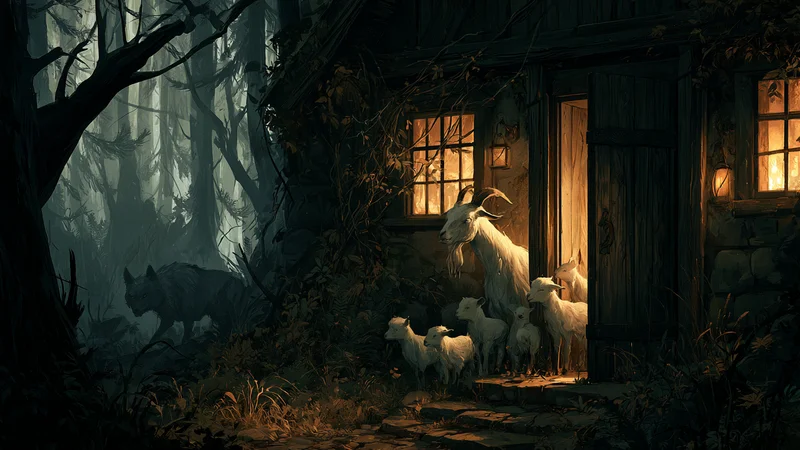
The wolf tried three times to gain entry. First with his rough voice—the little kids recognized him. Then he ate chalk and spoke softly—but the little kids saw his black feet. Then he had the miller whiten his paws with flour and spoke in a gentle voice through the window. The little kids opened the door. The one who came in was the wolf. He found all of them except the youngest, who had hidden inside the case of the grandfather clock. He swallowed all the others whole.
When the mother came home, the youngest little kid told her everything. They went out into the meadow, where the wolf lay beneath a tree, snoring so loudly that the branches trembled. Something was wriggling inside his belly. The mother fetched scissors, a needle, and thread, cut open the wolf’s belly, and one after another all six little kids jumped out, alive and unharmed. The children carried heavy stones, and the mother sewed them into the wolf’s belly. When the wolf went to the well and bent over the water, the stones pulled him in, and he drowned.
The seven little kids danced around the well with their mother.
What Is Really Being Told Here
At its core, this is not a warning about strangers, nor is it a reward for obedience.
It is an account of the ancient image of devouring and returning. And of what one brings back from the belly of the world after coming out again.
The Disguise
The wolf deceives them three times. Voice, paws, then voice and paws together—only on the third attempt does he succeed.
This is not a story about naivety. It is a story about recognition. The little kids test correctly—first the voice, then the appearance. The third time, both signs match. They did not make a wrong decision. They read the signs they had been given.
The wolf does not lie with words. He lies with his body. And that is the most dangerous lie—because it fulfills every sign by which he is supposed to be recognized.
The Youngest
The seventh little kid survives. It hides inside the case of the grandfather clock—the only place in the house that measures time. That is no coincidence.
It is the smallest. It is the one that was too small to be found. And it is the only one that can bear witness to what happened. It carries the story forward. Without it, there would be no return for the others.
The consciousness that cannot be devoured does not dwell in what is great. It dwells in the smallest, the most hidden place—in the one the wolf overlooked.
The Devouring
Here lies the center of the fairy tale. And it is the part most often misunderstood.
Cronus devours his children because he is afraid. Jonah ends up inside the whale because he flees. The little kids are devoured—without guilt, without choice, simply because the wolf finds them.
And yet they come out alive. Unharmed. The monster had swallowed them whole in its greed—that is the decisive line. They were not destroyed. They were held.
Being devoured is not an ending. It is a chamber. An in-between space. The darkest part does not come from being swallowed—it comes from what one does while inside. The little kids wait. That is all. And that is enough.
The Stone
Rhea gives Cronus a stone instead of Zeus. Mother Goat gives the wolf stones instead of the little kids.
The pattern is the same, spanning thousands of years. The stone as a substitute. The living is exchanged for what is dead, heavy, and hard—and the living survives.
But the stone is more than a trick. It is the weight that finally pulls the devourer back to the earth. Cronus must give up the stone again—and with it everything he had swallowed. The wolf drowns because of the weight. The stone ends the cycle.
What the living could not stop, the dead accomplishes. That is ancient knowledge.
The Mother
She does not weep for long. She goes out, looks carefully—she sees the movement inside the wolf’s belly—and acts.
Scissors, needle, thread. Three tools. She cuts open, then closes again. This is the work of the goddesses of fate—the Norns, who weave and cut. Mother Goat does not act here as an animal. She acts as a goddess.
And she ends it with dignity. No blood, no triumph. She sews the wolf back up and lets him go. He draws himself into the water.
What Moralizing Made of It
The message people remember is: Listen to your parents. Don’t let strangers in. Be careful.
Those are useful pieces of advice. But they are not the fairy tale.
The fairy tale itself does not ask about morality. It describes a process. The children are devoured—not because they were disobedient, but because the wolf was thorough. Because the signs matched. Because sometimes it simply happens.
And then they come back out. Alive. The fairy tale does not judge this. It shows it.
What moralizing obscures is the essential thing: trust in returning. The certainty that being devoured is not the end. That is not naïveté—it is the deepest knowledge this culture has passed down for thousands of years.
Conclusion
The Wolf and the Seven Little Kids is not a children’s story about obedience.
It is a story as old as the image of Cronus—the story of devouring and rebirth. The stone that replaces the living. The youngest, who cannot be found. The mother, who cuts open and sews closed again.
And the wolf? He is not a punishment for disobedience. He is a force within the cycle. He belongs there—just as Fenrir belongs to Ragnarök, just as winter belongs to Mother Hulda, who makes snow when she shakes out her feather bed.
What the fairy tale says is simple. And impossible to dissolve.
One can be devoured and still come back out. Alive. Unharmed. As though nothing had happened.
And yet something did happen. And the youngest knows it.
Unearthed From:
- Grimm original manuscript (1810) / first edition (1812) (KHM 5): https://www.grimmstories.com/de/grimm_maerchen/der_wolf_und_die_sieben_jungen_geisslein
- Comparison of the original manuscript and later versions: https://www.goethezeitportal.de/wissen/illustrationen/brueder-grimm/der-wolf-und-die-sieben-geisslein.html
- Cronus / Rhea / stone motif: https://de.wikipedia.org/wiki/Kronos
- Connection between Cronus and the fairy tale (wolf, Perchta, Perchten): https://anthrowiki.at/Kronos
- Amalthea – the goat as a goddess: https://de.wikipedia.org/wiki/Amaltheia
- Fenrir – the wolf as a cosmic force: https://de.wikipedia.org/wiki/Fenriswolf
- The relationship of the Germanic peoples to wolves: https://encyclopaedia.fandom.com/de/wiki/Verh%C3%A4ltnis_der_Germanen_zu_den_W%C3%B6lfen
- ATU 123 – international fairy tale type: https://de.wikipedia.org/wiki/Der_Wolf_und_die_sieben_jungen_Gei%C3%9Flein