Jack and the Beanstalk—a new study argues that this fairy tale is among humanity’s oldest and is around 5,000 years old. The beanstalk strongly resembles the myth of the World Tree, which connects Earth and Heaven. The first printed version dates from 1807 and was popularized in 1890 by Joseph Jacobs.
An ancient fairy tale, then—more than enough reason for us to dig a little deeper…
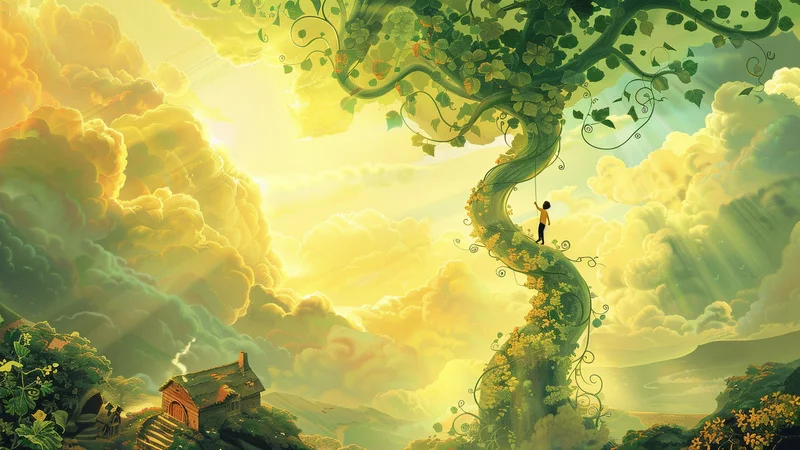
Jack sells his cow for beans. His mother is furious and throws the beans out the window. The next morning, a vine stretches all the way to the sky.
It sounds like a children’s story. Yet it contains one of the oldest images we have: a human being climbs out of one world into another. What he does there, and what he brings back, is worth a closer look.
Layer 1: The Tree That Connects All Worlds
Long before anyone wrote the story down, the image already existed.
Yggdrasil—the World Ash of Norse cosmology—connects nine worlds. Its roots reach the Well of Wisdom, the realm of the dead, and the world of chaos. Its branches hold Asgard, the world of the gods. Between the worlds stands the tree. Anyone who wishes to travel from one world to another must use it.
This is not uniquely Germanic knowledge. The World Tree appears in almost every culture—as a tree, a mountain, a ladder, or a vine. In shamanic traditions around the world, climbing this tree is the central act: the shaman leaves the ordinary world, ascends or descends into the Otherworld, and returns with something taken from there. For the community. At personal risk.
Jack climbs a beanstalk. The image is the same.
And what awaits him above? The land of the giants. In Germanic mythology, this is Jötunheim—one of the nine worlds and the home of the primal forces. Giants are not simply oversized humans. They are the personification of nature before all order: the power that raises mountains, shapes the weather, and shakes the earth. The Æsir gods were born from the blood of giants—and Yggdrasil itself grew from the body of a slain giant. Giants are primordial ancestors. Dangerous, untamed, and in a fundamental sense: older than everything that came after them. And it is to them that Jack climbs.
Layer 2: The Fairy Tale
English tradition, first printed in 1807 (Benjamin Tabart). Best-known version: Joseph Jacobs, English Fairy Tales, 1890. In German-speaking countries known as Hans und die Bohnenranke.
His mother is beside herself with anger. She throws the beans out the window. But the next morning, a vine has grown all the way into the sky.
Jack climbs the vine. At the top he discovers a strange land, a long road, and a gigantic castle. The wife of a giant opens the door. Jack is hungry and asks for bread. The giant’s wife feeds him—but when the giant returns home, she hides Jack inside the oven. The giant sniffs the air: “Fee, fi, fo, fum—I smell the blood of an Englishman!” But his wife calms him. The giant eats, counts his gold, and falls asleep. Jack steals a bag of gold and climbs back down the vine.
The gold is soon spent, and Jack climbs up a second time. Once again the giant’s wife feeds him, once again she hides him, and once again the giant falls asleep. This time Jack steals a golden hen that lays golden eggs.
But Jack climbs up once more, and on this third visit he steals a golden harp that sings by itself. The harp, however, calls out to its master. The giant chases Jack down the beanstalk. Jack barely manages to cut the vine down with an ax. The giant falls to his death. From that day on, Jack and his mother live in wealth.
What Is Really Being Told Here
The Exchange
Jack’s mother sends him to market with the cow. Jack returns with beans.
That sounds foolish, but it is the exact opposite.
The old man Jack meets recognizes him. He offers the trade because he knows who is coming. This is not the tricking of a naïve boy. It is recognition. The helping spirit—in shamanic cultures, the figure who sets fate in motion—recognizes the one who is ready to walk the ancient path. Jack accepts the exchange without hesitation. That is trust, not naivety.
The cow represents the ordinary world: it gives milk, it nourishes, it is what can be relied upon. Jack gives it up—without knowing in exchange for what. That is the first condition for everything that follows.
The Three Treasures
Jack climbs up three times. Three times he steals something different.
Gold—the golden hen—the golden harp.
This is not a random sequence. The three treasures describe three different forms of wealth: material capital, the self-renewing principle of fertility, and the creative—the harp that sings, art that expresses itself.
Prometheus steals fire from the gods. The Sumerian Inanna steals the Tablets of Wisdom from the underworld. The Australian culture heroes steal the Song of Origins. It is always the same motif: someone enters the world of the primal forces and brings back what humanity needs—not because they have a right to it, but because they are able to cross the boundary.
Jack is not a hero in the moral sense. He is a thief. The fairy tale makes no attempt to excuse that. Later versions turned the giant into a tyrant so that Jack could become a liberator—but that is a whitewashing that obscures the original. Ritual theft needs no justification. It is the principle itself: the gift comes from the place where the primal forces guard it. Whoever wishes to retrieve it must climb upward.
The Giant’s Wife
This is almost always overlooked.
The giant’s wife feeds Jack. Three times. She hides him, three times. She warns him, three times. Without her, he would already have died on his first visit.
She is the helper in the Otherworld—the same figure as Baba Yaga’s hospitality, the Devil’s grandmother, the witch who shows the way. The feminine within the world of the giants is not hostile. It is what makes the crossing possible in the first place.
Why does she help him? The fairy tale never says. Perhaps because she knows Jack had to come. Perhaps because the primal force embodied by her husband must be tamed so that something new can become possible.
The Harp That Calls Out
The golden harp does not want to be stolen.
Gold remains silent. The hen clucks only once. But the harp—art, creative power, the principle of the living voice—calls out to its master and, in doing so, betrays Jack.
This is not a flaw in the fairy tale. It is precision. The first two treasures can simply be taken. The third—the creative gift—cannot simply be seized. It sets the giant in motion. It forces Jack to make a decision: now, with everything he has.
Art cannot be stolen in silence. It insists upon its price.
Cutting Down the Beanstalk
Jack cuts down the beanstalk while the giant is still climbing it. The giant falls and dies.
This marks the end of the path between the worlds. The connection is severed. What Jack has brought back remains in this world—but the possibility of climbing upward again is gone.
This is not an accidental death. It is the completion of the passage. The shaman who returns brings back the gift—and closes the path behind him. What belonged to the Otherworld does not remain accessible. The beanstalk must fall.
The giant who dies upon it is neither a victim nor an enemy. He is the force bound to the path itself. When the path comes to an end, so does he.
What the Moralizing Interpretation Makes of It
The standard interpretation goes like this: Jack is lazy, unreliable, and naïve—yet he becomes rich anyway. Therefore the giant must be a villain, otherwise the fairy tale has no moral meaning.
That is an attempt to rewrite a shamanic image of initiation into a story about being rewarded. But it does not work.
Jack is not a model of diligence and obedience. He is the sort of person who trades a cow for beans—someone willing to give up what is reliable for something that cannot yet be proven. That is not a virtue in the bourgeois sense. But it is the only quality that makes it possible for someone to climb the beanstalk.
What the Fairy Tale Is Saying
There are worlds above this world. They are reached by way of a tree, a vine, a path that extends beyond what is visible. The entrance lies where we let go of what is reliable.
Above dwell the primal forces. Neither evil nor good. But ancient. What they guard rightfully belongs to humanity—but it has to be retrieved. And that comes at a cost. It costs the cow, it costs the threefold danger, and in the end it costs the beanstalk itself.
Whoever returns brings back three things: material security, self-renewing power, and a voice that sings—even if it betrays its master.
That is not a bad trade for five beans.
Unearthed From:
- Jacobs, Joseph: English Fairy Tales (1890). German-language version: https://www.maerchenstern.de/maerchen/bohnenranke.php
- The World Tree, Jötunheim, and ritual theft as a shamanic principle: https://inana.info/blog/2019/12/28/hans-und-die-bohnenranke
- Fairy tale classification, origins, first printed edition (1807): https://de.wikipedia.org/wiki/Hans_und_die_Bohnenranke
- Giants in Germanic mythology: Simek, Rudolf: Lexikon der germanischen Mythologie (Kröner, Stuttgart, 2006)