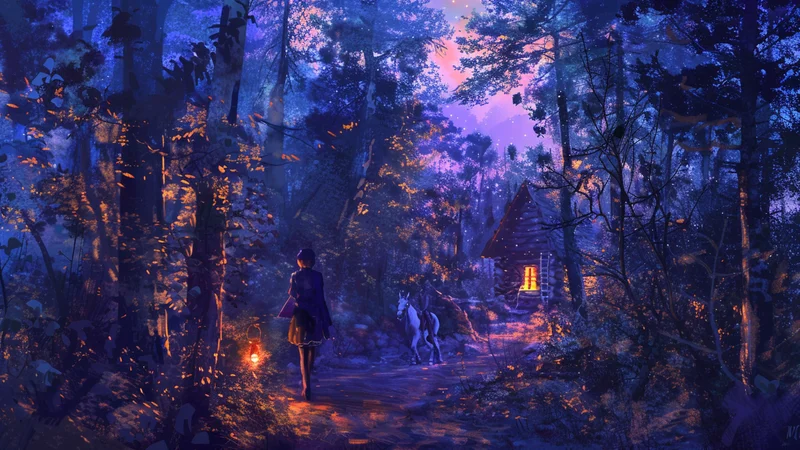
There are fairy tales that tell a story. And there are fairy tales that describe a path.
Vasilisa the Beautiful belongs to the second kind. The girl who is sent to Baba Yaga’s house to fetch fire—and returns with something far heavier than a burning skull.
So let’s take a closer look.
Layer 1: Who Is Really Waiting Here
Before we follow Vasilisa, we need to be clear about whom she meets.
Baba Yaga is not a witch. That is the version Christianity turned her into—over centuries, methodically, deliberately. What came before was something else entirely: one of the oldest goddesses of the Slavic world. Goddess of death and rebirth. Guardian of the threshold between worlds.
Baba is Indo-European—it originally did not mean “old woman,” but rather the primordial matriarch and earth mother. The etymology of Yaga remains disputed, but in none of its interpretations is she a minor figure. Slavic scholars place her alongside the Celtic Cailleach, the Old Norse Hel, and the Norns—a triple goddess: maiden, mother, and crone—in a single being.
Her house stands on chicken legs and turns. It has no windows facing the road. It looks only in the opposite direction—toward the world of the dead. That is not simply a fairy tale detail. The Slavic tribes built exactly such huts on stilts as houses for the dead: without doors, turned away toward the deep forest, standing between worlds. Baba Yaga’s house is a grave. Whoever arrives there stands at the boundary.
And the fence? Bones. Human skulls mounted on stakes. When Vasilisa arrives, those skulls begin to glow.
The fire Vasilisa has been sent to fetch therefore comes from the realm of the dead. From the heart of the darkness. From a goddess who has been rewritten as a witch for a thousand years—but whose true nature has remained unchanged all the same.
Layer 2: The Fairy Tale
Recorded by Alexander Nikolayevich Afanasyev in his collection of Russian folk tales (1855–1867), the Slavic equivalent of the Brothers Grimm collection. The tale itself is older than the written version—its roots reach back into pre-Christian Slavic tradition.
The father married a widow with two daughters. The stepmother gave Vasilisa the hardest chores—and the girl endured them. The doll secretly helped her. And Vasilisa grew more beautiful with each passing day, which only fueled the jealousy of her new family.
One evening, the stepsisters put out the only fire in the house and sent Vasilisa into the forest to Baba Yaga to fetch a new one. The girl was afraid and asked her doll for advice. And the doll said: Go.
On her way through the forest, she met a white rider on a white horse—and morning came. Then a red rider passed, and the sun rose. By evening she reached Baba Yaga’s house just as a black rider rushed past and night fell. The skulls on the fence lit up.
Baba Yaga greeted her with the words, “I smell human flesh.”
Vasilisa said she had come to fetch fire. The old woman answered, “Very well. But first you must work.”
Vasilisa cleaned the house, cooked, washed—everything impossible became possible through the doll. Baba Yaga asked, “How do you manage all this?” Vasilisa answered, “Through my mother’s blessing.” Then Baba Yaga said, “Be gone. I have no need for the blessed.” She gave the girl a glowing skull and sent her home.
When Vasilisa returned with the skull, its light burned the stepmother and the stepsisters to ashes. Vasilisa buried the skull, left home, learned to weave—and wove a cloth so fine that it reached the Tsar. The Tsar had Vasilisa brought before him, saw her, and married her.
What Is Really Being Told Here
The Doll
This is the heart of the fairy tale, and it is overlooked again and again.
Vasilisa inherits a doll from her dying mother. Small. Small enough to fit in the palm of her hand. Whenever the girl feeds it—providing it with what it needs most—the doll helps her. It whispers what she should do. It works through the night. It carries her.
This is not magic coming from outside. It is an image of what remains inside us when someone we love dies: a kind of knowledge that cannot be put into words. Not reason. Not a plan. Something much deeper.
The doll has to be nourished—with small sacrifices, with attention, with the willingness to listen. If you let it starve, it falls silent. Many people know that feeling. Most simply forget that there is an image for it.
The Three Riders
Baba Yaga calls them: “My bright dawn. My red sun. My night.” Not strangers. Not forces of nature. Her dawn, her sun, and her night.
The goddess who watches over life and death also governs the rhythm of the day. White, red, black—these are not merely colors. They are the three colors of the Great Goddess in many cultures: birth, life, death. The sequence that repeats itself again and again.
Vasilisa encounters them on her journey—she experiences morning, midday, and night before she arrives. She is led through the cycle before she stands before its guardian.
The Tasks
Baba Yaga does not set meaningless tasks. She assigns the work of the household—cleaning, cooking, washing. The very same chores the stepmother used to humiliate the girl.
Here, however, they become something else. Here they are a trial, not a punishment. The difference does not lie in the work itself. It lies in the spirit with which it is carried out.
Vasilisa does not complain. She asks the doll, begins—and accomplishes the impossible. What the stepmother used as a tool of humiliation becomes a gateway here.
“Through My Mother’s Blessing”
This is the sentence that changes everything.
Baba Yaga asks how Vasilisa manages the work. The girl tells the truth: through her mother’s blessing. And the goddess—the guardian of life and death, who poses riddles and devours heroes—sends her away. “I have no need for the blessed here.”
This is not rejection. It is a dismissal. Vasilisa has passed the trial—not through cleverness alone, not through diligence, but because she never lost the thread that connects her to where she came from. The doll, the blessing, the inner knowing—that is the only thing that matters at this threshold. And it is enough.
The Glowing Skull
Baba Yaga does not give the girl a lucky charm or a gift. She gives her a human skull—from the fence of the realm of the dead, glowing with an inner fire.
When Vasilisa returns home, that fire burns the stepmother and the stepsisters to ashes.
It sounds cruel. But it is precise, because what Vasilisa brings back from the realm of the dead cannot coexist with what had kept her trapped. The light that comes from the depths clears away what stands in its way. Not out of revenge—but because otherwise there would be no room for it.
Fire from the realm of the dead spares nothing.
What the Moralizing Interpretation Makes of It
The usual summary goes like this: Vasilisa is obedient, hardworking, and beautiful—so she is rewarded. The wicked stepsisters are punished. That is the surface, and it is misleading.
The fairy tale does not reward Vasilisa for being obedient. It shows what happens when someone has not lost the inner thread—the doll, the blessing, the voice that must be nourished—even though everything around them has worked to silence it.
The stepmother is not a villain simply because she is evil. She is the image of a force that wants to separate the girl from herself. Every person knows that force in one form or another.
And Baba Yaga is not an examiner judging good behavior. She is the threshold itself. You come to her when you have to descend into the depths. You return—if you are able to hold on to and carry back what you found there.
What the Fairy Tale Is Saying
Not: Be obedient, and everything will turn out well. Rather: There is something inside you that knows.
It is small. It needs nourishment. If you keep it alive—if you keep listening, even when no voice remains except that one quiet one—then you can walk into the darkest forests, to the boundary between worlds, into the house of the goddess of death.
And you return. With fire.
That fire is not harmless. It burns away what no longer belongs. That is its nature.
Vasilisa did not know that when she set out. But she had the doll—and that was enough.
Unearthed at:
- Afanasyev, Alexander: Russian Folk Tales (1855–1867). Original text of the Vasilisa tale online: https://ichigokomori.wordpress.com/2016/04/13/wassilissa-die-wuenderschoene-ein-maerchen-ueber-baba-yaga/
- Baba Yaga as the Goddess of Death, mythological origins (Working Group for Comparative Mythology): https://www.vergleichende-mythologie.de/baba-jaga-baba-yaga-todesgoettin-gefuerchtete-hexe-wundersame-heilerin-teil-1/
- Funerary huts on stilts, burial rituals, broom: https://artedea.net/baba-yaga/
- Baba Yaga on Wikipedia (etymology, reception): https://de.wikipedia.org/wiki/Baba_Jaga
- Triple Goddess, comparison with Hel, the Norns, and the Cailleach: https://www.vergleichende-mythologie.de/baba-jaga-baba-yaga-todesgoettin-gefuerchtete-hexe-wundersame-heilerin-teil-1/
- The colors white/red/black and the three riders: https://www.heilsames-erzaehlen.de/schoene-wassilissa/