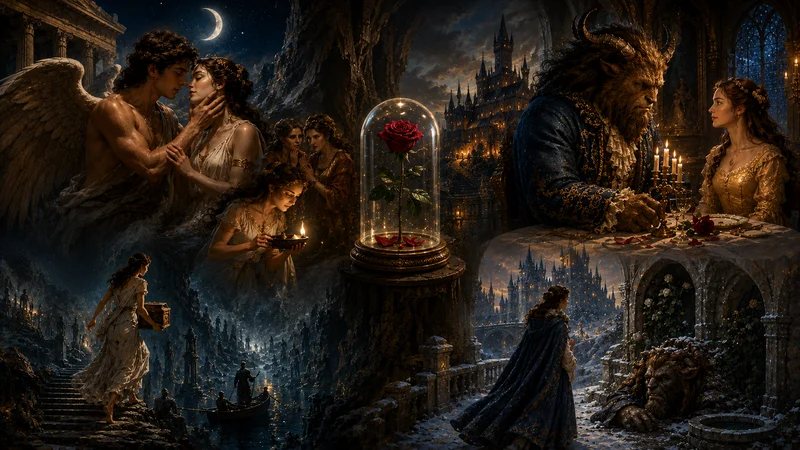
Here we turn our attention to a very old story. British and Portuguese researchers estimate its age at somewhere between 2,500 and 6,000 years.
The first European written version appeared in 1740 through Gabrielle-Suzanne de Villeneuve, who drew on Italian motifs from the 16th century.
But its true origin is older: Cupid and Psyche from Apuleius’ Metamorphoses (2nd century)—although Apuleius himself drew on even older Greek folk tales. There are at least 140 folktales from across Europe and Asia that share the same elements: mysterious bridegrooms, wicked sisters, impossible tasks, journeys into the underworld.
Because this story is very long, we’ll summarize it and begin by looking from above into its depths…
Version 1: Apuleius, 2nd Century AD
From Metamorphoses (The Golden Ass), Books IV–VI, the oldest surviving written version of the motif
This enraged Venus. She summoned her son Cupid and ordered him to make Psyche fall in love with the most miserable, despised man in the world. Cupid set out—and when he caught sight of Psyche, he struck himself with his own arrow. He fell in love with her.
Meanwhile, Psyche suffered. Everyone admired her, but no one sought her hand. Her sisters were married. She remained alone. Her father consulted the Oracle of Apollo—and the oracle declared that his daughter must be left on a lonely mountain dressed as a bride. Her husband would not be mortal, but a being feared even by the gods and the underworld itself.
And so it happened. Psyche sat alone upon the mountain—and Zephyr, lord of the winds, gently carried her down into a blooming valley before the entrance of a marvelous palace. No one was to be seen, yet voices spoke to her, invisible servants surrounded her.
When night fell, a stranger came to her bed. She could not see his face. He spoke with her, loved her—and with the first light of dawn he was gone. So the nights passed. Psyche learned to love him without knowing who he was.
Then she was allowed to visit her sisters. They saw the splendor, they saw Psyche’s happiness—and jealousy consumed them. They convinced Psyche that her husband must surely be a hideous monster who concealed himself by night. She should hide a lamp, keep a knife nearby, and look to see what truly slept beside her.
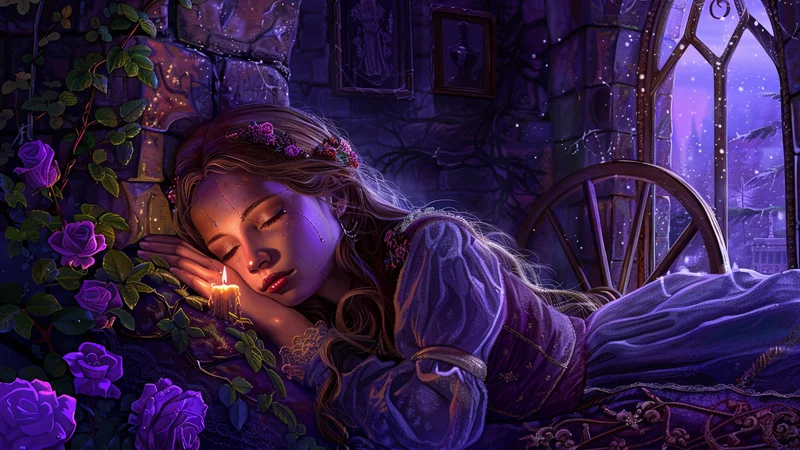
Psyche obeyed. With trembling hands she lifted the lamp over her sleeping husband—and beheld the most beautiful of all the gods. Cupid. The god of love himself. In her shock, a drop of hot oil fell from the lamp onto his shoulder. He awoke, looked at her—and flew away without a single word.
Psyche threw herself into the nearest river. The river carried her alive to the shore. From there, her wandering began.
Venus, now knowing what her son had done, received Psyche in fury. She gave her four impossible tasks.
First: Sort a mountain of mixed grain before evening—and ants came to help her.
Second: Gather golden wool from dangerous rams—and a reed by the river whispered that she should wait until the rams rested, then collect the wool caught on the bushes.
Third: Draw water from the river of the underworld—again she received help, this time from an eagle.
Fourth: Bring back a box of beauty from the underworld and deliver it unopened to Venus.
Psyche descended into the underworld. She retrieved the box. But on the journey back—almost at her destination—overcome by curiosity, she opened it. And she fell into a sleep like death.
Cupid, now healed from his wound and escaped from his mother’s chambers, found Psyche lying there. He wiped the sleep from her, returned it to the box, and awakened her.
He asked Jupiter, father of the gods, for permission to marry her. Jupiter granted it. Psyche was made immortal and welcomed among the gods. Venus was reconciled with her. And the child born to Psyche and Cupid was named Voluptas—Delight.
Version 2: Gabrielle-Suzanne de Villeneuve, 1740
La Belle et la Bête – the first known modern version. Written for an adult audience, novella-length (362 pages), greatly condensed here.
Villeneuve published her work in 1740 for an adult audience, addressing questions that deeply affected the women of her time—above all, criticism of marriage laws that left women with almost no rights: no right to choose a husband, no right to refuse marriage, and no right to divorce. Brides were often only fourteen or fifteen years old and were given to men decades older than themselves.
A wealthy merchant lived in a great city with his twelve children. Six sons, six daughters. The youngest daughter was called—by everyone who knew her—simply: la Belle. The Beauty. Her sisters were proud and vain; she was neither.
When the merchant lost his fortune, the family moved to the countryside. The sisters complained. Belle worked. The father set out on a journey to recover what remained of his wealth—and asked his daughters what they wanted him to bring back. The sisters wanted dresses and jewelry. Belle asked for a rose.
On his way home, lost in the snow, the merchant came upon an illuminated castle. Tables were set, fireplaces were burning, yet not a single soul was there. He ate and slept. The next morning—as he was leaving the castle garden—he picked a rose for Belle.
Then the Beast appeared.
Villeneuve describes it this way: not a man with a lion’s head, but a true monster with a trunk like an elephant, covered in scales, roaring—and asking the merchant in a terrifying voice: Who gave you permission to pick my roses?
The Beast condemned the merchant to death. It allowed him to return home to say farewell to his family—but on one condition: one of his daughters had to take his place willingly.
Belle came. The castle surrounded her with every luxury. Every evening the Beast dined with her. Every evening it asked the same question: “Will you sleep with me?”
Belle said no. The Beast accepted it. The next evening it asked again.
Between those evenings, they talked. And Belle realized something she had never expected: the Beast was intelligent. Attentive. Honest to the point of bluntness. It never lied. It never laid traps. It was ugly—and had a better character than any handsome man she had ever met.
But then—Belle grew homesick. The Beast let her leave—with a magic ring: if she placed it on the table and fell asleep, she would wake the next morning back in the castle. It asked only that she return after one week.
Belle stayed away longer. When she finally returned, she found the Beast dying beside the well—it had stopped eating after she failed to come back. She knelt beside it and said what she now knew: she loved him. She wanted to marry him.
At that moment the Beast transformed into a prince. An ancient curse was broken. The good fairy who had cursed him—or rather, who had saved him from an evil fairy and in doing so had herself been forced into creating this form—explained everything. Belle, it turned out, was of royal birth herself. Their union had been destined from the beginning.
And the wicked sisters? They were turned into statues before the castle. Until their hearts should soften.
What has been told here for 2,000 years
Two stories. The same question. How does the soul encounter love—when love hides itself?
Psyche—that is not a name. It is a program.
Apuleius did not invent this. He wrote it down. And he knew exactly what he was doing. Psyche is the Greek word for soul. Cupid is love. The story is literally about how the soul seeks love, finds it, loses it—and finds it again. Not as an allegory. As the description of a process.
The soul begins with admiration that isolates it. Everyone looks, no one comes closer. Perfect beauty makes a person untouchable. That is the first paradox.
Then love arrives—and hides itself. It comes only in the darkness. It sets one condition: Do not look at me. Do not recognize me. Trust without proof.
And the soul cannot hold on to that.
The Lamp
This is the decisive moment. Not the descent into the underworld, not the tasks—the lamp.
The soul lifts the light. It wants to see what it loves. That is not a weakness. It is the nature of the soul: it cannot endure what remains unseen. It has to understand what it loves. The price is that it loses it. And it finds it again only after passing through everything—the sisters’ jealousy, the goddess’s wrath, the underworld, the sleep of death. Only then is it allowed to keep what it has seen.
The message is this: Knowledge has a cost. Whoever wants to see must be willing to lose—and to search.
Villeneuve knew exactly what she was doing
France. Women have no rights within marriage. They are given away. To whom—that is decided by others.
Villeneuve is not writing a fairy tale for children. She is writing for women. And every evening the Beast asks the same question—directly, without evasion: Will you sleep with me?
No metaphor. No courtly circling around the subject. The most honest question a man can ask a woman.
And Belle says no. Every evening. The Beast accepts it. Every evening.
That is the true miracle of this story. Not the transformation. Not the curse. But this: a being that looks like a monster and behaves more humanely than a human being. And a human being who looks like other people—and behaves like a beast.
Belle learns to distinguish. Not surface from depth. That would be too simple. She learns to sense what a being truly is—beyond appearance and social standing.
Sixteen years later, Beaumont shortened the story for young English girls, softening the sensual elements and the implicit criticism of forced marriages. What had been social criticism in Villeneuve became a lesson in virtue in Beaumont. What had been subversive became well-behaved. The fairy tale fragment in action.
What does not die in either story
The impossible task. It has to be endured. There is no shortcut. But there is help.
Psyche sorts grain, gathers wool, draws water from the underworld, descends into death—and returns.
Belle offers herself as a sacrifice and discovers a love she was never looking for.
In both cases, the decisive movement is the same: the heart must see what the mind rejects.
And in both stories, what is hidden is not the terrible thing—it is the beautiful thing.
The terror is the shell. The beauty is what lies within. Not because ugliness is always goodness in disguise. But because we have learned to judge by outward appearances—and in doing so have forgotten how to look inward.
This is the message that has survived for 4,000 years.
Not the moral. Not virtue. Not the reward for obedience.
Rather—the soul does not find love by following it. It finds love by passing through everything that lies between itself and love—doubt, curiosity, betrayal, trial, the underworld. And it arrives.
Unearthed at:
- Cupid and Psyche (Apuleius) summary: https://www.maerchenatlas.de/kunstmarchen/apuleius/amor-und-psyche/
- Cupid and Psyche original German text: https://www.projekt-gutenberg.org/hausrata/griemaer/chap022.html
- Wikipedia: Cupid and Psyche: https://de.wikipedia.org/wiki/Amor_und_Psyche
- Villeneuve original French text (1740, Wikisource): https://fr.wikisource.org/wiki/Contes_de_Madame_de_Villeneuve/La_Belle_et_la_B%C3%AAte
- History of the fairy tale (Villeneuve vs. Beaumont): https://disappointinglymuddy.wordpress.com/2021/04/09/la-belle-et-la-bete-beauty-and-the-beast/
- Age research (2,500–6,000 years): https://la-porte-du-bonheur.com/de/blogs/blog/wassilissa-die-sehr-schone-und-baba-jaga-russisches-marchen-1
- German Wikipedia: https://de.wikipedia.org/wiki/Die_Sch%C3%B6ne_und_das_Biest_(Volksm%C3%A4rchen)