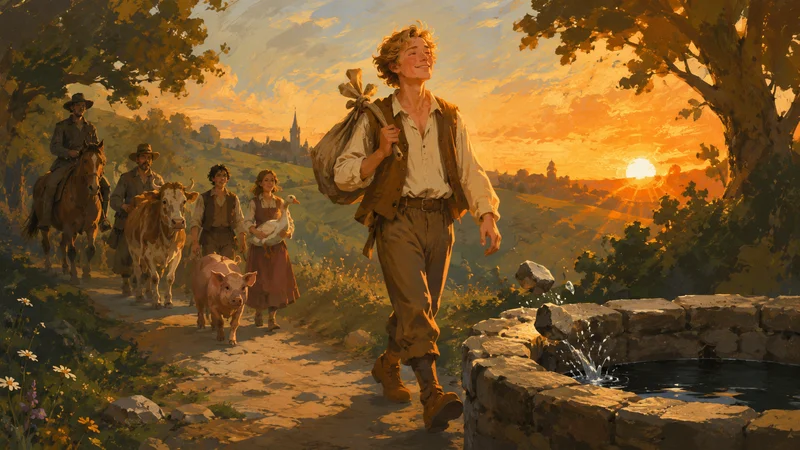
Hans is quieter, lighter, and calmer than his fellow fairy tale characters, because he does not fight, he does not search, and he does not truly suffer. He simply walks.
Hans in Luck first appeared in the journal Wünschelruthe, where Friedrich August Wernicke had published it a year earlier (1818) under the title Hans Wohlgemut. The Brothers Grimm adopted it beginning with the second edition of 1819.
It does not begin with: “Once upon a time.” That is the first sign.
Almost all of the Brothers Grimm’s fairy tales begin with those words. Hans in Luck does not. It begins: Hans had served his master for seven years. And now he wants to go home. To his mother.
No backstory. No origin. No magic. Only this: someone is going home.
What Is Not a Fairy Tale
Strictly speaking, Hans in Luck is not a fairy tale. There are no witches, no talking animals, no wizards, no fairies. Not a single supernatural element.
The only thing that is wondrous is happiness itself. Good fortune clings to Hans the way bad luck clings to other people.
That is the story. A man walks a road. Loses everything along the way. And in the end is freer than he was at the beginning.
The Chain
Seven years of work. The reward: a lump of gold as large as his head, as heavy as a small boulder. Hans carries it. For a while, at least, until it becomes too heavy.
A horseman rides by: What good is gold when you could have a horse? Hans trades and happily rides on. The horse throws him off.
A farmer with a cow comes along: What good is a stubborn horse when you could have a gentle cow? Hans trades again and is already thinking of butter and cheese. But the cow gives no milk.
A young man appears with a pig: What good is a lame cow when you could soon be eating sausages? Hans trades. And looks forward to the roast.
But once again something unpleasant happens—the pig, someone says along the road, has been stolen.
A girl carrying a goose comes by: What good is a suspicious pig when you could have fine goose fat? Hans trades and walks on, the goose tucked under his arm.
He meets a knife grinder: What good is a goose when you could become a grinder yourself and earn your own living? Hans trades, receiving a grindstone and a heavy fieldstone besides. But the stones grow heavier with every step.
Hans comes to a well. He sets the stones on its edge, bends down to drink, and accidentally nudges them so they fall into the well.
He watches them disappear. He kneels down and thanks God with tears in his eyes that even this burden has been taken from him.
Then he jumps to his feet and continues on his way. To his mother. With nothing at all.
“There is no one under the sun as happy as I am!” he cried.
What Is Really Happening Here
He did not decide to let go of the stones. He dropped them by accident.
That is the decisive sentence—and it is never stated explicitly in the text. But it is there.
Hans did not have to throw away what burdened him. He simply let it fall.
That is the difference between renunciation and letting go. Renunciation is a decision—it costs something, it requires willpower, it keeps the memory of what was given up alive. Letting go simply happens. It is not an act. It is the ending of an act.
Hans does not hold on. That is all.
What Everyone Else Does
Every person Hans meets takes advantage of him. The horseman praises the horse. The farmer praises the cow. The young man praises the pig. The girl praises the goose. The knife grinder praises his trade.
Everyone he meets convinces Hans that whatever he has at the moment is worth less than what he could receive instead.
From the outside, that sounds like deception. And it is deception—from an outside point of view. But Hans never experiences it as deception. He hears the praise and thinks: Yes, that’s true. And he trades.
He never compares with what he had before. He compares only with what is being offered now. That makes him impossible to deceive.
You can deceive only someone who clings to what they possess. Hans never clings. There is nothing anyone can take from him that he has not already let go of himself.
The Gold and the Stone
The sequence of exchanges follows a logic that, from the outside, looks like a steady decline: gold, horse, cow, pig, goose, stone.
From the most valuable thing of all to the most worthless lump.
But in alchemy—the old tradition, not the modern one—there is a path that looks exactly like this. The goal is not gold. The goal is the Philosopher’s Stone. The inner gold. What emerges only by passing through the loss of material possessions.
Hans begins with heavy outward gold and ends with nothing. And therefore with the lightest thing there is: himself.
What is lost in the worldly sense is gained in the spiritual one. The fairy tale never says this. But it shows it.
The Stones in the Well
The final image is the most powerful one.
Hans is kneeling at the edge of the well. The stones are gone. And Hans thanks God—with tears in his eyes—not for what he has received, but for what has been taken away from him.
That is not resignation. It is recognition.
He knows the stones were never his possessions. They were his burden. He carried them only for a while because he did not know how to set them down. The well did it for him.
The well—that says so much. In every ancient culture, the well symbolizes the entrance to something deeper, to the unconscious, to the source. What falls into the well does not return. What falls into the well belongs once more to the one it has always belonged to: the earth.
Hans gives it back. Without knowing that he is doing so.
What Almost No One Understands—Not Even Hans
He is not a wise man. He is not a saint. He is not a monk.
He has not absorbed any teaching. He has not meditated. He has never given himself a rule to follow.
He is simply someone who wants to go home. Someone who always accepts the next thing that comes along. Who never looks back. Who never asks what he has given up.
And for precisely that reason, what happens to him is what others spend their entire lives striving for.
The philosopher Ludwig Marcuse wrote: Happiness is found neither in gold, nor in the pig, nor in the stone. Many things can make a person happy, but no possession can make a person happy in every respect.
Hans never thought that. He simply lived it.
The Ending
He arrives at his mother’s home. Not with a treasure. Not with a princess. Not with a castle. He arrives with empty hands and a light heart.
His mother was the destination from the very beginning. Seven years of work, and then: finally home. Everything in between—the exchanges, the losses, the moments of liberation—was simply the journey itself.
The fairy tale ends where it began. Not with wealth. With coming home.
Whoever possesses nothing anymore except themselves—so the fairy tale says—is perhaps truly happy.
This is not a moral lesson, not a magical formula, not a recipe, and not an instruction. It is an observation. It is the story of someone who simply let every burden fall away.
Our Dig Sites
- Grimm original text (Wikisource): https://de.wikisource.org/wiki/Hans_im_Gl%C3%BCck
- Wikipedia – Variants and interpretations: https://de.wikipedia.org/wiki/Hans_im_Gl%C3%BCck
- Märchenatlas – Analysis, tale type, structural motifs: https://www.maerchenatlas.de/deutsche-maerchen/grimms-marchen/hans-im-glueck/
- Hans in Luck and a Buddhist interpretation: http://www.saekularerbuddhismus.org/?p=2382
- Interpretation of Being vs. Having (Erich Fromm): http://www.leixoletti.de/interpretationen/hans.htm
- Life’s journey as the path of the sun, an alchemical interpretation: https://erzaehlkarawane-ammersee.de/geschichtenundinterpretationen/bruedergrimm/hansimglueck/hansimglueck_interpretation.php