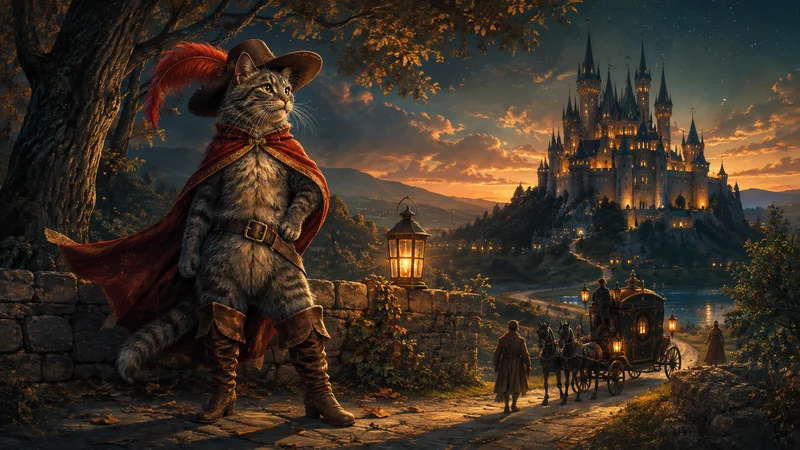
Terry Pratchett wrote a sentence that really makes everything else unnecessary: “In ancient times cats were worshipped as gods; they have not forgotten this.” Puss in Boots is proof of that.
Here, too, we found some really powerful material once we dug deeper. Female cat or tomcat?
We go back to Straparola’s story in Venice around 1550, only to discover that Basile’s version has a completely different ending, and – Perrault even left that out in 1697, but in return he made the cat male and invented the boots.
And the Brothers Grimm in 1812? They adopted Perrault’s version and then even removed parts of the fairy tale. The cat becomes minister. And so a story about ingratitude became a success story.
And yet – this version, too, has a really interesting message. Let’s get started:
What the Grimms Hid
The Brothers Grimm removed the fairy tale after the first edition of 1812. The reason: It was too obviously non-German. It came from France, before that from Italy, before that from even farther away. But they wanted German fairy tales. And this one was too honest about where it came from.
What they did not remove: the basic structure. A cat lies, deceives, and kills – and rules in the end. Apparently, that did not make them uncomfortable.
What the Cat Demands
A miller dies. Three sons inherit: the eldest the mill, the middle son the donkey, the youngest the cat. The youngest is disappointed. What is he supposed to do with a cat? But perhaps his fur might still make a pair of gloves?
And then the cat speaks. He says: Give me boots. Then I’ll take care of the rest. Not: Give me freedom. Not: Let me go. He wants boots. So that he can – as the text literally says – show himself among people.
This is not a request for equipment. It is a demand for dignity. For visibility. For the right to appear as someone who matters.
He gets the boots. And then the game begins.
What the Cat Does
He lies. Systematically, precisely, incessantly.
He brings partridges to the king – as a gift from his master, the count. The count does not exist. The miller’s son is not a count. But the king believes it because the cat says it with conviction.
He arranges a bath in the lake – he sends the miller’s son into the water, hides his clothes, and when the king drives past, he cries: Robbers! Thieves! They have taken everything from the count! The king provides clothes of his own, has the handsome young man brought into the carriage, and continues on with him.
The cat runs ahead – through fields, through forests – and impresses upon every farmer: If the king asks who owns all this, answer: the count. Anyone who disobeys will be quartered.
The farmers obey. And then he stands before the castle of the most powerful sorcerer in the land.
The Death of the Sorcerer
This is the part everyone reads as a joke. The cat outwits the sorcerer: Can you really transform yourself into anything? Into a lion, into an elephant? The sorcerer demonstrates. Impressive. And then: But into something very small – a mouse, perhaps? Surely that would be really difficult.
The sorcerer transforms himself into a mouse. The cat eats him.
This is not a trick. It is murder. The cat kills the owner of the castle in order to hand it over to his master. Cold-bloodedly, methodically, with one last little conversation beforehand.
That’s what the fairy tale says, but it is never addressed.
Before There Were Boots
Perrault made the fairy tale famous, the Grimms removed a great deal. But who invented it?
Now we come to Venice, around 1550. Giovanni Francesco Straparola writes his The Facetious Nights – the first European fairy-tale collection to truly gather folk tales. Among them: Costantino Fortunato.
An old poor woman in Bohemia dies and leaves her three sons the little she has: a kneading trough, a bread basket – and a cat. The youngest son, Constantino, inherits the cat.
No boots, and a female cat instead. But – the same structure – a deception, a king, a princess, a castle. The cat does everything without boots. Because she doesn’t need them.
Eighty years later, Naples, 1634. Giambattista Basile writes the Pentamerone – and his version is called Cagliuso. The same story, but with a different ending.
Cagliuso thanks his cat profusely and promises her anything she wishes. She is to be embalmed after her death, so great is his love for her. Then the cat pretends to be dead. She lies motionless on the floor and puts Cagliuso to the test. And she hears what he really says: He wants to throw her out the window.
The cat gets up, looks at him, and leaves. With a single sentence: She has wasted her time on an ungrateful man.
That is Basile’s ending. The moral of the original fairy tale: Ingratitude destroys everything.
Then Perrault comes along and removes the ending. He invents the boots, turns the cat into a male master who lives like a great lord. A fable about the nature of ingratitude becomes a success story.
And the Grimms adopt Perrault’s version. The cat becomes prime minister. The most honest ending disappears.
What remains: a fairy tale that no longer knows what it originally wanted to say.
The Final Sentence of the New Version
The miller’s son marries the princess and becomes a count. And when the king dies, he becomes king.
“But Puss in Boots became prime minister.”
That is the final sentence. Not the fortunate miller’s son. Not the princess. The cat. He did not want freedom – he wanted power. He got it.
The entire story was not a service to his master. It was a plan for himself. The miller’s son was the means. The boots were the first step.
There is no explaining that away. It is right there.
Who the Cat Really Is
He is the trickster. The oldest figure in human history – in every culture, in every age. Hermes, the messenger of the gods, who is also the god of thieves. Loki, the troublemaker and rescuer. Anansi, the spider who steals stories. Coyote, who throws the world into disorder and creates it in the process.
The trickster crosses boundaries. He lies, but he lies methodically. He destroys, but something new emerges from the destruction. He is a culture hero – someone who, through his actions, whether he intends to or not, changes the world.
He appears in animal form: hare, spider, coyote, wolf, raven. And cat.
Puss in Boots is Hermes in boots. Loki in a fur hat. He needs no divine ancestry – he needs cunning, agility, and the willingness to play by the rules without believing in them.
What the Cat Knows That Humans Have Forgotten
Bastet. Egyptian goddess of joy, music, dance, fertility, protection. Daughter of the sun god. Originally a lioness – then a cat. Gentleness did not replace the destructive power; it merely concealed it.
The Persians painted Bastet on their shields when they fought against Egypt. The Egyptians could not fight – not against their own goddess. They lost the battle.
Freyja rides on wildcats. Not horses, not eagles. Cats. The goddess of love is also the leader of the Valkyries, who choose the fallen.
And the Scottish legend: Cait Sith, the spirit cats, are witches who transform themselves. The ninth transformation into a cat is permanent. That is why – according to tradition – cats have nine lives.
Nine lives. Nine forms. Nine identities.
The cat wears boots because he wants to move among humans. But he never became entirely human. He is something that knows both worlds and belongs completely to neither.
The Lie That Becomes True
What stands at the end of the fairy tale is a paradox.
Everything the cat told them was a lie. The count did not exist. The lands did not belong to him. The castle did not belong to him. The miller’s son’s entire existence as a count was a construction – built from words, assertions, intimidation.
And then it is true after all.
The miller’s son is king. The castle is his. The lands are his. Because enough people played along – because the king played along, the farmers played along, the princess played along. Because repeating a lie eventually turns it into reality.
We know this – we find it everywhere in our world … This is not a fairy tale about cunning as a virtue. It is a reflection on power. On how social reality comes into being. On what a title is, what a castle is, what a king is – once you expose the construction beneath it.
The cat knew that. That’s why he demanded boots, not freedom. With freedom, he would have remained an animal. With boots, he could lie among humans – in their language, and by their rules. And with those rules, he won.
Prime minister – they haven’t forgotten.
Unearthed at
- Original Grimm text, 1812 (Wikisource): https://de.wikisource.org/wiki/Der_gestiefelte_Kater_(1812)
- Wikipedia – origins, variants, removal by the Grimms: https://de.wikipedia.org/wiki/Der_gestiefelte_Kater
- Märchenatlas – Basile, Straparola, Perrault: https://www.maerchenatlas.de/deutsche-maerchen/grimms-marchen/der-gestiefelte-kater/
- Trickster as an archetype (Wikipedia): https://de.wikipedia.org/wiki/Trickster
- Bastet – cat goddess, daughter of the sun god: https://de.wikipedia.org/wiki/Bastet
- Cait Sith, Freyja, cat mythology around the world: https://herz-fuer-tiere.de/haustiere/katzen/katzen-mythologie